09Nov
Cao Shui on Rebuilding the Tower of Babel, One Origin of Humanity, and One World:
In a peach orchard in Beishanyun village, a boy slipped away to read under the fruit trees, retelling his grandfathers' tales until his classmates called him a gifted storyteller. That boy became Cao Shui. Today, Cao Shui is one of China's most translated writers — poet, novelist and translator whose works have reached 48 languages. He leads the Great Poetry Movement and the Poetry Film Movement. His journey was never straightforward. He resigned from a newspaper job in 2008 to wander through Tibet and Xinjiang, endured hardship, and turned that wandering into the bestselling Kunlun Secrets and Epic of Eurasia. In this conversation with CAJ International Magazine, he speaks about his childhood, the illustrated Bible that gave him the Tower of Babel, and why humanity shares one origin and must find one world. He also speaks directly to Africa — its ancient civilizations, its young poets, and the Epic of Africa waiting to be written. Excerpts:
Dear Dr. Cao Shui, we are honored to feature you. This interview covers your background, education, works, and Africa–China exchange. Where were you born and raised?
I was born in Yushe County, Shanxi Province, in the heartland of ancient China — the Central Plains. It is the ancestral home of the legendary Emperor Yan, nestled in the Taihang Mountains at the source of the Zhang River, a tributary of the Hai River. I spent my childhood in the village of Beishanyun, where we had a peach orchard in the north and an apple orchard in the south. I often slipped into the orchards alone to read, spending much of my boyhood in the shade of the fruit trees, which gave me a closeness to nature from an early age. According to our family genealogy, we are descendants of Cao Cao, the protagonist of Romance of the Three Kingdoms. Cao Cao and his sons, Cao Zhi and Cao Pi, were all great poets, so I took pride in this lineage from childhood. My direct ancestor was Cao Guang of the Ming dynasty, and my great-grandfather was a local squire. By my grandfather's generation, after the land reforms, we had become ordinary farmers. My grandfather, Cao Shengsuo, would tell historical tales by the heated brick bed, while my maternal grandfather, Guo Haijiang, loved telling legendary stories. I would retell them to others and became known from a young age as a gifted storyteller. As for my grandmothers, both passed away before my parents grew up — a lasting regret in my heart. It was in such a family, full of books and orchards, of history and legend, that my interest in literature and narrative took root early.
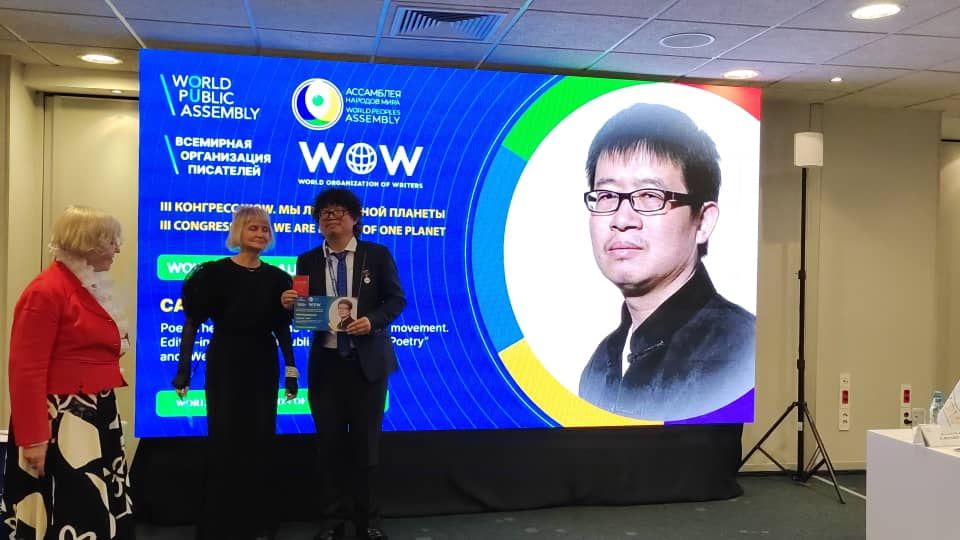
In 2026, Cao Shui received the World Writers' Organization Laurel Award in Moscow; Margareta Al, president of the World Writers' Organization, presented him the certificate and medal.
Tell us about your parents — who are they, what do they do, and what values from them shaped you?
My father, Cao Jiangang, graduated from a technical secondary school with a degree in fruit-tree science. He worked as a fruit-tree technician, ran two orchards at home, and often helped others prune their trees. He loved reading, especially books like the I Ching. My earliest exposure to the Eight Trigrams and metaphysics came through his books. The seeds of the mysticism that recurs throughout my works, such as Kunlun Secrets, were planted there. We were not wealthy, but he was always willing to buy me books — something crucial to my later writing. My mother, Guo Aihua, was an ordinary homemaker, but she had remarkably high intelligence. She could solve everyday arithmetic in her head, fast and accurately. She had to drop out of school in her youth because her own mother passed away early. There are four siblings in our family, and we probably inherited our intelligence mostly from her — my younger sister is now a chemistry PhD at the Chinese Academy of Sciences. My mother's greatest influence on me was the conviction that I must leave the countryside through knowledge. Of course, I went further, often travelling abroad. My father gave me the Eastern metaphysical foundation; my mother gave me diligence and intelligence. These two sets of values still shape my writing and my life today.
What is your earliest childhood memory that still influences your writing today?
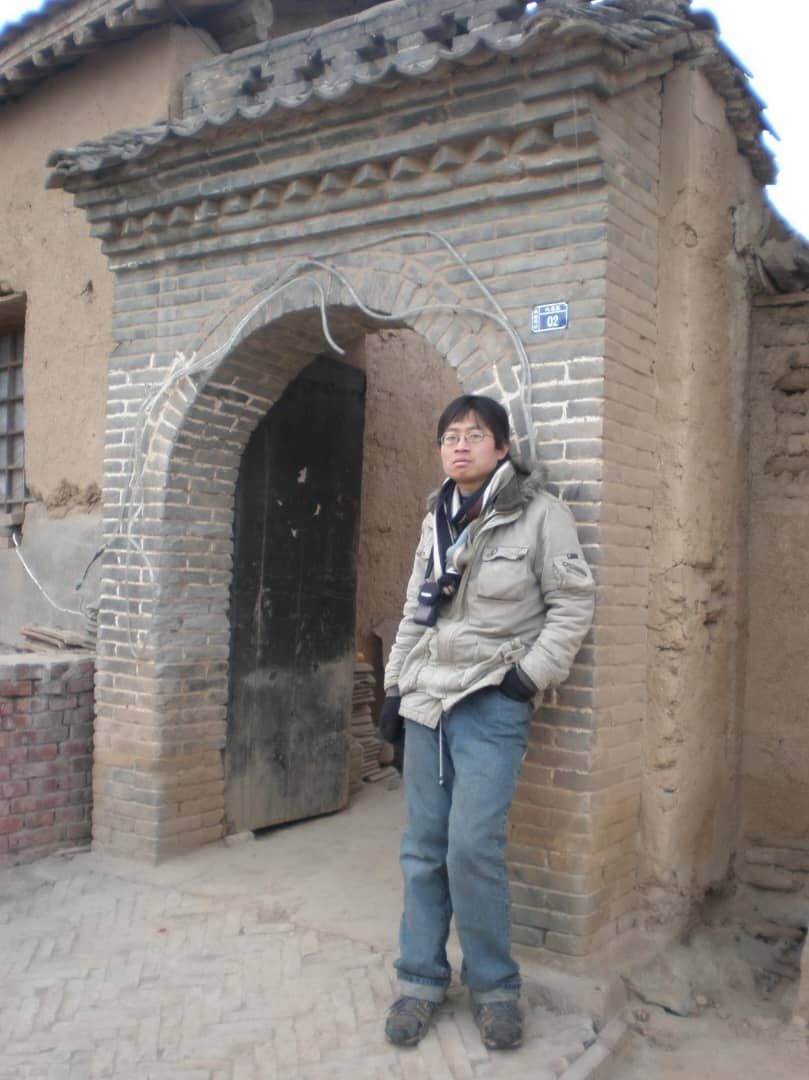
Around 2008, Cao Shui at the old courtyard house in his hometown, where he grew up.
When I was in primary school, my younger brother Cao Chunbo brought me back an illustrated Bible from a church in the nearby village of Nanshanyun. Those novel stories captivated me at once, especially the story of the Tower of Babel: humanity once spoke one language and built a tower to heaven together. Fearing for His authority, God confused their tongues, and so people scattered across the world to form different peoples. This story stayed with me as a kind of regret throughout my childhood, so I later made “rebuilding the Tower of Babel” the most important theme of my work. My first novel was The Tower of Babel Peak, and later I wrote Song of the Tower of Babel, Kunlun Secrets III: The Tower of Babel, and a series of other works. Our region was traditionally Buddhist; every village had a temple, and the appearance of that one lone church brought Western civilisation concretely into my life. This was the original seed of my later proposal of the Great Poetry Movement and my advocacy of “the meeting of East and West” — in fact, Eastern and Western civilizations had already met in my childhood village, with temple and church standing side by side.
What did young Cao Hongbo dream of becoming before becoming Cao Shui?
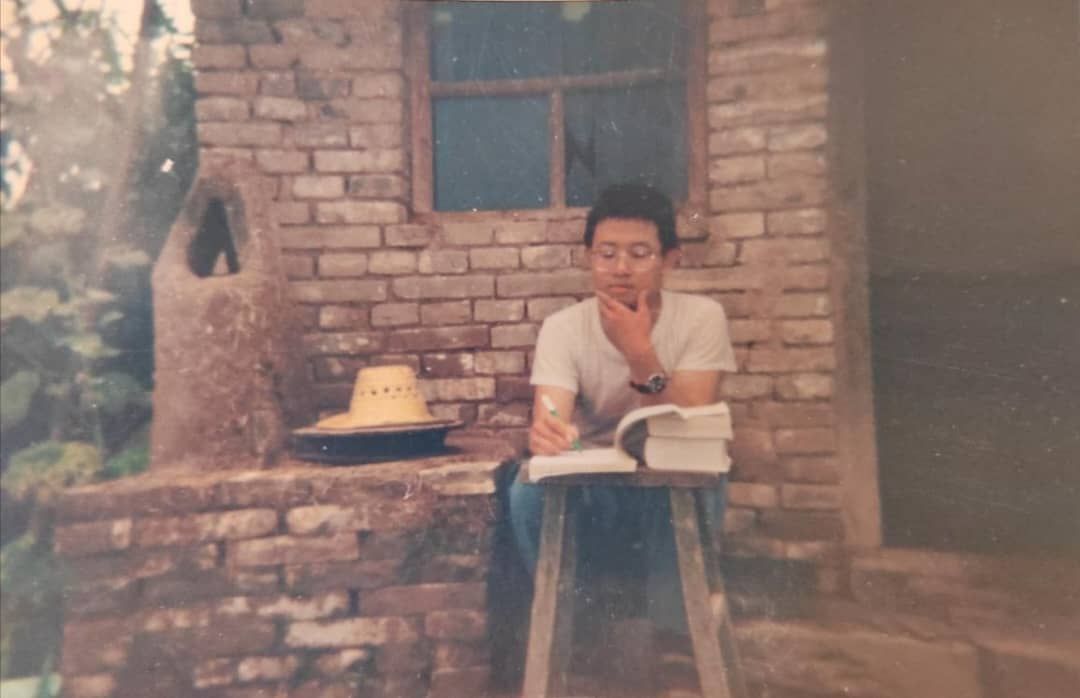
Around 1998, the teenage Cao Shui reading in the Beizheng orchard.
Before becoming “Cao Shui,” the young Cao Hongbo harbored an imperial dream. Our region is ancient Central Plains land with many famous historical figures, but the one who moved me most directly was Shi Le, the emperor of the Later Zhao dynasty during the Northern Dynasties period — I often passed by his imperial tomb. He rose from a slave to become emperor, and I was full of admiration for him from childhood. The earliest poem I can find is “The Broken Straw Hat”: “I, wearing a broken straw hat, survey the world.” My classmates called me the “Straw Hat Poet.” My junior-high English teacher, Shi Suling, once asked everyone about their dreams. I wrote “military strategist” and earned the nickname “Commander Cao.” So my interest in literature came later, but my pursuit of power and conquest never disappeared — it dissolved into my Great Poetry Movement, Poetry Film Movement, and Dramatizing Fiction Movement. The preface to my The Tower of Babel Peak is titled “When a Man Cannot Conquer the World with a Sword, He Chooses the Pen” — almost a portrait of my life's creed: when the sword is impossible, use the pen, to conquer and to rebuild the spiritual order of the world.
When did you first fall in love with poetry and was there a book, teacher, or event that sparked it?
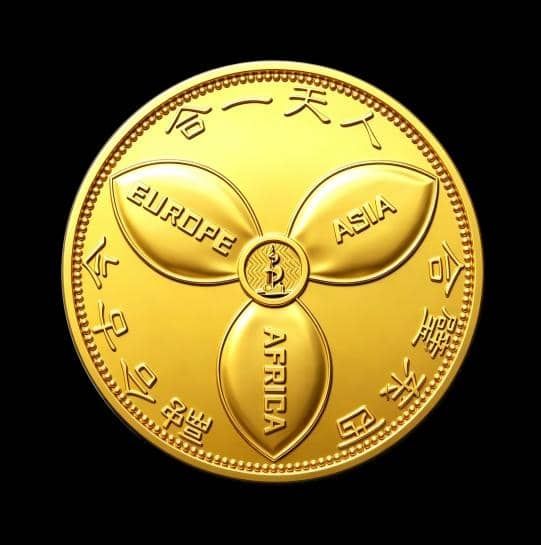
In 2007 Cao Shui launched the Great Poetry Movement; in 2023 he established the Great Poetry Movement Medal, awarded each year to poets worldwide who have made outstanding contributions to great poetry or the epic.
My real interest in literature began in the third year of junior high, in 1997. I remember my Chinese teacher, Yue Yongtai, reading one of my compositions aloud to the whole class as a model. In that moment, I truly felt the power of words. I also began keeping a diary in 1997 and have written more than one hundred volumes totaling over ten million characters — my fast writing ability was trained day after day in this way. Later Chinese teachers, including Qiao Jintang, Zhang Xiaoguang, and Cui Xiaodong, encouraged me in the same way. But what truly ignited my love of poetry was Hai Zi's “Asian Bronze” in our language textbook. The first time I read it, I felt a vast metaphor for the world, a great state of “unity of heaven and man,” and from then on I began to write poetry. One could say that Hai Zi's “Asian Bronze” was the key that opened the door of poetry for me — it made me realise that poetry is not just lines of text, but a way of illuminating the whole universe and uniting the self with the world. Every path I have taken since carries the faith in the power of words that was kindled in that third year of junior high. How did you choose your pen name Cao Shui, English name Shawn Cao, and hao “Lord of the Tower of Babel”? My pen name has gone through a clear evolution. My first pen name, adopted in 2003, was “Xunyan” — xun is an ancient Chinese wind instrument, and “Xunyan” means “the wailing of the xun,” reflecting the melancholy I pursued in my youth. In 2005, I began using the pen name “Cao Shui”: “Cao” represents the great Eastern tradition, the descendants of Zhurong, the god of fire; “Shui” is the Chinese word for “Who,” a Greek-philosophical questioning. The name itself means “the meeting of East and West.” The English name Shawn Cao I adopted in 2011 while studying English at Beijing Language and Culture University, because Shawn is close in sound to Shui, and I used it until 2017. Then I met the Turkish poet Nurduran Duman, and while discussing English pen names, she suggested I use the pinyin of my Chinese name, Cao Shui, to preserve my Eastern identity — and so it became the pen name now widely used internationally. “Lord of the Tower of Babel” is my hao. In the Eastern tradition, a person has a name, a courtesy name, and a hao. The Tower of Babel Peak is the name of my study, signifying my aim to rebuild the Babel tower of human literature. My courtesy name is “Ya'ou” (Eurasia), expressing my lifelong pursuit of fusing Eastern and Western civilizations.
Walk us through your education from primary school to your Master's in Literature at Beijing Normal University in 2020. Why did you return mid-career?
I entered Beishanyun Experimental Primary School in 1990, the only experimental primary school in Xima Township, and I was a top student from the moment I entered. In third grade, I began writing compositions, weaving the stories told by my grandfather and maternal grandfather into them with embellishment, and in storytelling class, I would often hold my classmates spellbound. In 1995, I entered Yushe No.1 Middle School. In the third year of junior high (1997), I began my diary, which now totals more than ten million characters. My composition about the return of Hong Kong was read aloud by Teacher Yue Yongtai as a model, and from then on, I loved writing. In senior high, I read and imitated the European avant-garde schools — Expressionism, Surrealism, and so on — through my teachers Qiao Jintang, Zhang Xiaoguang, and others. In 2002, assigned by the college entrance examination system, I entered Qinghai Nationalities University. At first, I felt my talent went unrecognised, but later I found delight in the multicultural ethnic life there. In 2003, I adopted the pen name “Xunyan” and founded the Xiangying Literature Society. In 2005, I proposed the idea of the Great Poetry Movement, and in 2007, I wrote the systematic Manifesto of the Great Poetry Movement. After graduation, I worked as an international news editor at Xihai Metropolis Daily, resigning two years later to become a full-time writer. Because I had never been admitted to my ideal university, I always wanted to return to school. In 2017, Beijing Normal University opened a writers' master's programme and Mo Yan came to teach there, so I returned to Beijing Normal University to pursue a master's in literature. Inspired by my supervisors, Zhang Ning and Zou Jingzhi, I founded the Poetry Film Movement and the Dramatizing Fiction Movement, and through Nurduran Duman, I joined the World Poetry Movement. Two international writing residencies let me meet writers from many countries, my works were translated abroad and won various international literary awards, and I gradually became an international writer — the nickname “International Cao” dates from then. Mr. Qiu Huadong once said, “three years for a small achievement, five for a medium one, and ten for a great one,” and I am proceeding along that plan.
In 2008, you resigned from a newspaper job to travel Tibet and Xinjiang, which you call the center of Eurasia. What led to that decision?
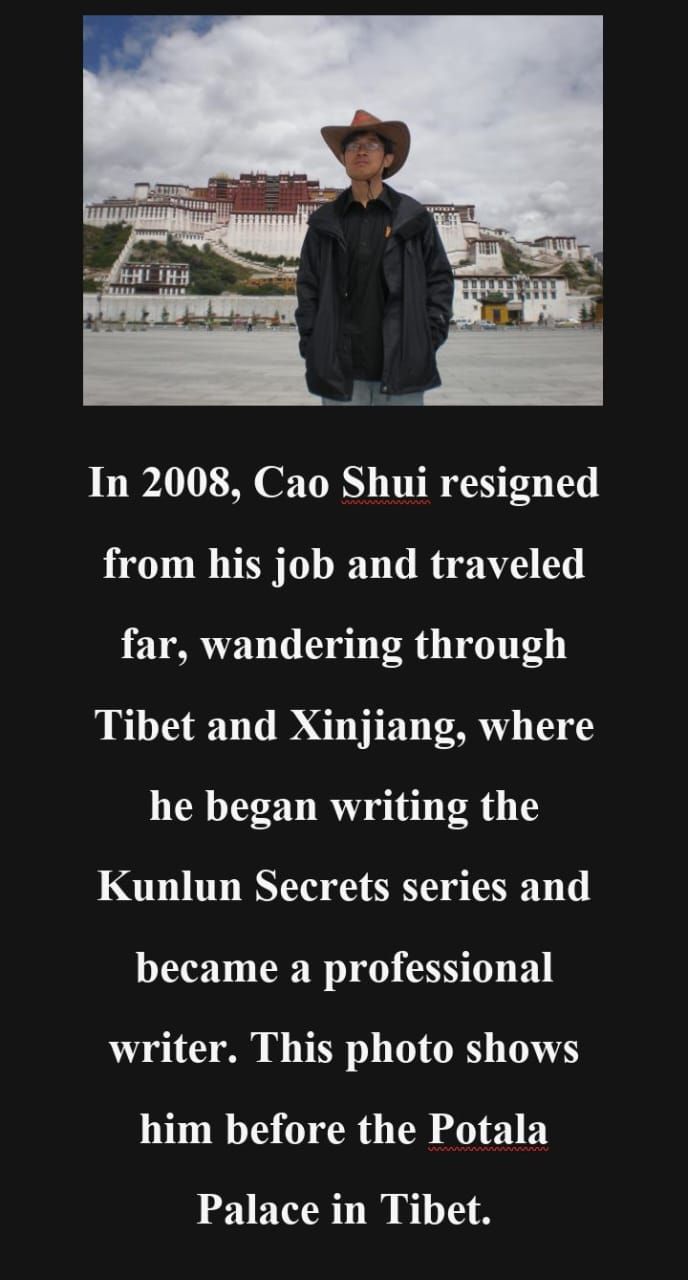
In 2006, I began working as an international news editor at Xihai Metropolis Daily, and in 2008, while covering the Olympics, I often worked overtime until dawn. Around that time, I was writing Epic of Eurasia with great fervour, and it suddenly struck me that my life should not pass so placidly — I should write a great work and establish a new order for humanity. So I resigned before the deputy editor-in-chief, Zhang Xiaoying. She asked whether I was changing jobs. I said I was going to seek freedom. She couldn't help laughing, finding it a rather absurd reason, and said I could come back whenever I wished. And so I resigned and set off on my “Great Kunlun–Eurasia” journey — west to Tibet, east to Xinjiang — which I call “resigning to travel far.” It was the most romantic decision of my life, and it carried a rebellion against the rigid examination system. Over the following months, I took whatever vehicle came, stayed in whatever inn I found, and wrote poems, travel notes, and plans for Kunlun Secrets in the evenings. During this journey, I completed the core chapters of Epic of Eurasia and wrote the travelogue Journey to Kunlun. More importantly, I conceived and wrote the five-volume Kunlun Secrets — the best-selling series that eventually made me a professional writer.
When did you know writing would be your lifelong profession and how did your family react?
I decided to make writing my lifelong profession after resigning in 2008. The newspaper job was stable and well paid, so my family naturally opposed it — but I resigned anyway. I remember calling home from Lhasa to tell them my decision, and they were clearly against it. For the following years, I had little contact with them, until Kunlun Secrets became a bestseller. In the Sino-Tibetan and Indo-European language families, “Kunlun” means “heaven,” so the series is sometimes translated as Secret of Heaven. The Kunlun Secrets series includes Axis of Time, The Imperial Seal and the Roman Crown, The Tower of Babel, the prequel The Tower of Babel Peak, and the finale The Universal Kingdom. Its theme, like that of Epic of Eurasia, is “one origin of humanity, one world” — all civilizations spread from one place, and the novels tell this in the form of suspense. This book was conceived during my travels. After I returned, I faced a financial crisis, living in a humble urban village with no heating in winter, but I never gave up writing even in the hardest times. Published in 2010, it became a bestseller and was even widely pirated. I received a large royalty, bought a house, and from then on began my professional writing career in earnest.
You now hold ten honorary doctorates in literature. How did that journey happen?
Because I failed to be admitted to my ideal university back then, I have always carried a sense of regret — probably a kind of psychological compensation. After earning my master's in literature from Beijing Normal University in 2020, I kept wanting to obtain a doctorate in literature, but writing kept me too busy. At the beginning of this year, I received an honorary doctorate in literature from the World Federation for Arts, Literature, Peace and Culture (FEMALPC), registered with the United Nations, and afterwards, I received honorary doctorates in literature successively from institutions and universities in Italy, Egypt, Peru, and other countries. There is also a rather amusing reason: my younger sister is a PhD, and my family calls her “Dr. Cao,” so deep down, I must have held a conviction that I too should be called “Dr. Cao.” Today, I hold ten honorary doctorates in literature — recognition of my years of literary creation and cross-cultural communication, and the fulfilment of that unfinished wish of my youth. For me, an honorary doctorate is not a terminus but a reminder to keep using literature as a bridge connecting Eastern and Western civilizations and humanity's shared spiritual home.
You lead the Great Poetry Movement. In one sentence, what is “Great Poetry” and why does the world need it now?
So-called great poetry is the great poetry that “unites past and present, meets East and West, and harmonizes heaven and man” — in short, “every poem can illuminate the whole universe.” The concept of great poetry originates in India, where it originally meant the epic — Gilgamesh, the Homeric epics, and the Indian epics are all typical examples. Later, this spirit entered other literary genres and became a spirit of fusion.
Why does the world need great poetry today?
Because our world is dividing — two hundred countries, two thousand peoples, six thousand languages, each behind its own walls, estranged from one another. Only through great poetry can we fuse the literatures of all peoples into a great poetry belonging to all humanity. This is not only a literary meaning but an enormous influence on the human spirit: all the wars and chaos in the world today can ultimately be traced back to this. If people could realize that we come from one place and are bound for one place, many conflicts might be resolved. This is the most practical meaning of the Great Poetry Movement today.
In your Manifesto, you aim to integrate sacred/secular, East/West, ancient/modern cultures. How do you practice this?
Fusing the sacred and the secular, the Eastern and the Western, and the ancient and the modern pervades every level of my work. In my view, human literature has broadly gone through the following course: from the lyrical literature of the agricultural age, dominated by poetry, to the narrative literature of the industrial age, dominated by the novel, and then to the dramatic literature of the information age, dominated by the film script. I myself have broadly followed the same course. My work falls into six series: the Kunlun Secrets series, the Tower of Babel series, the Sanjiangyuan Animals series, the Qinghai Local History series, the Dramatizing Fiction series, and the Freehand Deconstructionism series. The first four are thematic series. To take Kunlun Secrets as an example, it moves from the verse epic Epic of Eurasia to the five-volume novel Kunlun Secrets, and then to the Kunlun Secrets films, completing the transformation across poetry, fiction, and film. The last two are short-fiction styles: the Dramatizing Fiction series is adapted from my film works, while Freehand Deconstructionism deconstructs Eastern and Western civilizations in parallel — for instance, Romeo and Zhu Yingtai deconstructs classic Chinese and Western love stories, Cleopatra and Wu Zetian deconstructs the stories of the Chinese and Egyptian queens, and Shakuntala and Emperor Xuanzong deconstructs Chinese and Indian drama. From theme to genre to style, I practice this ideal of fusion in depth.
Your work always returns to Eurasia, Tower of Babel, and Kunlun Mountains. Why is this your spiritual homeland?
Eurasia, the Tower of Babel, and the Kunlun Mountains are the ideal paradigm of the world I have constructed. Eurasia is mainly embodied in the Kunlun Secrets series — in the medieval age, human civilization was largely distributed across the heartland of Eurasia: from Babylon westward to Canaan, Egypt, and Greece, and eastward to Persia, India, and China. Though Egypt is in Africa, this is meant in a cultural-geographical sense: if we can unite these seven great civilizations at their roots, most of humanity's conflicts would be resolved. The Tower of Babel is a biblical motif, but it is deeply rooted in human civilization, and many civilizations have similar legends. If humanity could rebuild the tower to heaven, all languages could be unified and human civilizations would fully understand one another, so in the Tower of Babel series, I want to build a Tower of Babel Peak. The Kunlun Mountains are wondrous — in the ancient Xiongnu language of the Sino-Tibetan family and the Tocharian language of the Indo-European family, “Kunlun” means “heaven.” On the modern map, this mountain range spans western China, but in antiquity, it may have been the sacred mountain of all civilizations, akin to Greece's Mount Olympus or the Caucasus. If we realize that Kunlun is the holy mountain of human civilization, we will realize that we should rebuild a common ideal commonwealth.
Epic of Eurasia has been translated into more than a dozen languages. What made you decide to write an epic for all humanity?
Epic of Eurasia is a work I wrote for all humanity, and it has now been translated into more than a dozen languages — English, Arabic, Italian, and Russian have been published, and translations into French, Spanish, Portuguese, Swedish, Finnish, Mongolian, Kazakh, Kyrgyz, and others are underway. What prompted this decision was my thinking about literary history: traditionally, humanity has had only national epics — Gilgamesh, the Greek epics, the Indian epics — each belonging to a single nation. But in today's globalized world, I believed I must write an epic belonging to all humanity. This epic takes Eurasia as its stage — the cradle of human civilization — setting out from Mesopotamia, westward to Canaan, Egypt, and Greece, eastward to Persia, India, and China, which are precisely the seven cores of human civilization. What I want to do is extract elements from these ancient civilizations and rebuild a common ideal commonwealth for humanity.
Your Kunlun Secrets (Secret of Heaven) trilogy tells the whole history of human civilization. How did your 2008 travels shape it?
The 2008 journey directly shaped Kunlun Secrets. That year, I resigned and travelled far, west to Tibet and east to Xinjiang — exactly the region of the Great Kunlun Mountains. Along the way, I gathered a great many cultural-geographical stories about Kunlun, and these stories ultimately crystallized into the Kunlun Secrets series — the route of the protagonist Long Hao is essentially the route I travelled myself. One could say that Kunlun Secrets is not merely a suspense-adventure novel; it is a work in which, after measuring Kunlun on my own feet, I wove together the legends, history, and civilizational memory of that land. Beneath the shell of a suspense story, it carries the grand theme of “one origin of humanity, one world,” stringing together the narratives of the seven great civilizations — Babylon, Persia, India, China, Canaan, Egypt, and Greece — through the protagonist's search for the Axis of Time, the Imperial Seal and the Roman Crown, and the Tower of Babel. Precisely because of this, the work has both a vivid geographical texture and a path toward the shared historical imagination of all humanity. You also lead Poetry Film Movement and Dramatizing Fiction Movement.
Where is the future of poetry — page or screen?
I believe the essence of all art is “poetic spirit,” which is why Aristotle's Poetics and Horace's Ars Poetica actually study all of literature and art, not just the genre of poetry. In 2017 I wrote the Manifesto of the Poetry Film Movement: since we now live in an age of drama, poetry must unite with film, and so I advocate the Poetry Film Movement. That same year I also wrote the Manifesto of the Dramatizing Fiction Movement: since many screenplays never end up as films, I advocate adapting scripts into novels. So I don't think we need to worry about poetry's future — the poetic spirit will not die; it only transforms into other genres and continues to grow: today it is transforming into film, and tomorrow into newer art forms. The future of poetry lies neither solely on the page nor solely on the screen, but in every new medium the poetic spirit reaches. As long as humanity has the instinct to question and express, the poetic spirit will continue to renew itself in new forms — that is the original intention behind my founding of the Poetry Film Movement and the Dramatizing Fiction Movement.
You have 50+ books, TV series King Peacock, films and fairy tales. How do you manage all these forms?
In the Manifesto of the Great Poetry Movement I advocate the ideal of “great poetics,” whose core is that all genres can be transformed into one another. Human literature has gone from the lyrical literature of the agricultural age, dominated by poetry, to the narrative literature of the industrial age, dominated by the novel, and then to the dramatic literature of the information age, dominated by the film script; the future is an age of world literature. My six series are, in essence, transformations among poetry, the novel, and the screenplay. For example, Epic of Eurasia is a long poem; transformed into fiction, it becomes the five-volume Kunlun Secrets, and transformed into film, it becomes the Kunlun Secrets films and TV dramas; my fairy tale Snow Leopard Prince has likewise been adapted into a stage play and is being developed as animation. So I am not managing many isolated creative forms; rather, through a unified vision of great poetics, I let the same spiritual core flow freely and keep growing across different genres — this is why I can simultaneously command poetry, fiction, screenplays, and fairy tales.
Your works are in Arabic, Hausa, Swahili, Amharic, etc. Why is South-South literary exchange important to you?
Many of my literary works have indeed been translated into the languages of the South, especially Arabic and Spanish. This has much to do with the great poetics I advocate — I place world literature on an equal footing, being neither Western-centric nor Chinese Eastern-centric. There are two hundred countries in the world, and each produces its own great poets and great works; only by bringing all these voices together can we build a true world literature. South-South literary exchange matters so much to me precisely because it breaks the pattern in which a few powerful civilizations dominate literary discourse, allowing African, Latin American, and Asian literatures that have long been marginalized to converse with the world on an equal platform. In my view, this is precisely the Great Poetry spirit made real: humanity shares one origin, and the world will ultimately be one. Therefore South-South exchange is not only mutual literary assistance; it is a necessary path for awakening the consciousness of the human community.
As Asian Coordinator of World Poetry Movement and Chinese Representative of BRICS Writers Association, how can BRICS writers build an alternative canon?
Today the West largely holds the discourse of world literature, and I believe we should rebuild the literary canon within a broader global framework. The World Poetry Movement launched by Fernando Rendón and the BRICS Writers Association launched by Vadim Terekhin are both part of this effort. Eastern and Western civilizations, and the countries of the South and the North, should jointly lead world literature, not leave it to a single civilization to decide. People today focus on the Nobel Prize in Literature; the Nobel is important, but we should build a pluralistic system of literary evaluation — the BRICS Writers Award is a good choice, and so are the laureate awards of the World Writers' Organization and the Great Poetry Movement Medal. For BRICS writers to build an alternative canon, the key is to step beyond Western-centric standards, extract elements from their own civilizations and the shared human spirit, and build a truly pluralistic, egalitarian world-literary evaluation system in which all literatures mirror one another.
You have received Egyptian awards including Golden Papyrus. What is your connection with Egypt and Arab literature?
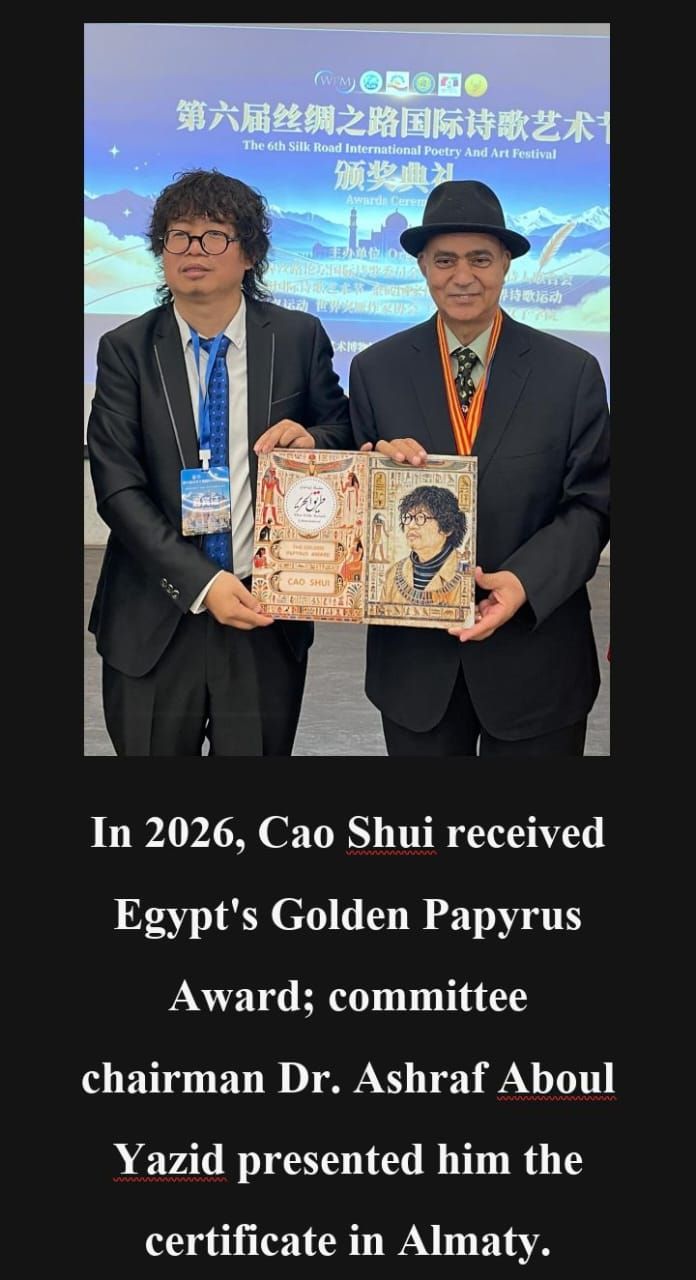
I entered the Egyptian literary world through the translation of the translator Ashraf Aboul Yazid. He translated my Epic of Eurasia, and for this book I received Egypt's important Golden Papyrus Award; I also received a series of literary awards at the Egyptian Golden Poetry Forum of Literary Thinkers, for which I am grateful to Dr. Salwa A. Ali, chair of the forum's board. In my Epic of Eurasia, Egypt is listed as one of the seven centers of civilization. As for Arab literature, I believe it must be traced back to Babylonian, Akkadian, and Aramaic literature — I often tell readers that Arab literature is in fact the truly most ancient literature, and that Gilgamesh is the farthest origin of Arab literature. For years I have maintained a deep literary exchange with Egypt and the Arab world — not only receiving translations and awards, but also continuously studying and translating Arab poetry, from Gibran, Adonis, and Mahfouz to many contemporary poets; I keep excavating the civilizational elements in them, and regard Arab civilization as a central pillar of the temple of world literature.
What does Africa mean to you as a Chinese writer of Eurasia? How can African and Chinese writers/journalists collaborate?
To me, Africa is the birthplace of all humanity. On the reverse of the Great Poetry Movement Medal is printed the ancient three-leaf clover map of Asia, Europe, and Africa. I may even add chapters to Epic of Eurasia in the future and rename it Epic of Afro-Eurasia. Because of colonialism, Africa is largely in a developing state, but precisely for this reason China should cooperate closely with African writers and journalists in literature, so that Chinese literature — in both content and genre — can become a model of world-literary cooperation. Africa possesses the oldest human civilization and the most vibrant indigenous culture, while at the same time forming a strong binary opposition with colonial culture; there are countless stories here waiting to be written. A side note: my elder son is named Cao Ya'oufei (Asia-Europe-Africa) and my younger son Cao Ya'oula (Asia-Europe-America) — these two names represent the two directions of the fusion of world civilizations. I have placed my expectations for Africa and for the whole world in the names of the next generation, and I hope that through continued literary cooperation, these expectations can be turned into reality.
As Foreign Academician of Brazilian Academy of Letters, what have you learned from Latin American literature?
This year I had the honor of being elected a foreign corresponding academician of the Brazilian Academy of Letters, which holds special significance for me. I have learned a great deal from Latin American Surrealism — a literature that fuses dreams, myth, and reality, and that resonates wonderfully with my Freehand Deconstructionism. I once took part in the Medellín International Poetry Festival, which played a very important role in my stepping onto the international poetry stage; I also translated Fernando Rendón's Songs of the Ideal Commonwealth, through which I glimpsed the shape of humanity's future ideal commonwealth. Most recently, Issue 16 of the Brazilian Academy of Letters journal published my Romeo and Zhu Yingtai — a great honor for me. I am now conceiving stories between China and Latin America — between these two civilizations, thousands of miles apart, there must lie shared memories of love and destiny not yet fully written, and they too deserve to be written into a great poetry belonging to all humanity. This is the direction in which I continue to work as a foreign academician of the Brazilian Academy of Letters.
What are you working on now that CAJ readers should expect in 2026/2027?
Recently I have been writing Princess Lilac, the companion piece to my Snow Leopard Prince, which is being adapted into animation — also a model work of my Dramatizing Fiction Movement. In addition, I am working on a series of Freehand Deconstructionist works, including Romeo and Zhu Yingtai, Cleopatra and Wu Zetian, and Shakuntala and Emperor Xuanzong — all works where Eastern and Western civilizations meet; each uses parallel narratives to let figures from two civilizations separated by millennia meet, collide, and illuminate one another. For CAJ readers, I would say: in 2026 and 2027, you can look forward to new works in which I fuse the civilizational elements of China, Egypt, India, Latin America, and Africa — attempts both to take Chinese literature to the world and to bring the world back to China. I especially hope African readers can find in these stories emotions and memories belonging to all humanity; that is the original intention behind my continued writing and translating.
You have won 100+ awards from 30 countries. Which award humbled you the most?
I have indeed received more than a hundred awards from more than thirty countries, but I have always felt that every award is unique to me. There are two hundred countries in our world, and the Nobel Prize in Literature is not the only one — this is precisely why I have long advocated a pluralistic world-literary award system. If I were to introduce the most recent one, I would mention the World Writers' Organization's 2026 Laurel Award: I received it together with five other world-class writers, including the great African writer Soyinka. This award humbles me not only because it recognizes me personally, but because it is an important step I took together with writers like Soyinka toward establishing a fairer and more pluralistic award system for world literature — it proves that the literatures of Africa, Asia, and the whole world are being seen equally. This is what I have always pursued: that the voices of every continent and every civilization may be heard in the temple of world literature.
What is your message to young African poets and journalists who want to write their own Epic of Africa?
“Epic of Africa” — this is a wonderful theme, and I sincerely hope to read such works. From the perspective of Great Poetry elemental poetics, I suggest that young African poets and journalists extract elements from Africa's ancient civilizations — ancient states such as Egypt, Ethiopia, Mali, and Zimbabwe are rich in civilizational elements. Africa was once almost entirely colonized by the West; I believe it is inherently marked by the binary opposition between indigenous culture and colonial culture, and it is precisely within this opposition that countless stories worth writing grow: resistance and fusion, memory and trauma, tradition and modernization. I hope young African writers will not merely repeat Western narrative models, but return to the deepest roots of their own civilizations — from the pyramids to Great Zimbabwe, from the stone city to the golden legends of the Mali Empire — to distill Africa's own spiritual elements and write a great epic that truly belongs to Africa and to all humanity. In the pens of Africa's young poets and journalists lies the first spark of human civilization.
Comments
