07Oct
By Khaled Suleiman
Africa remains the world's richest continent in resources but poorest in living standards, trapped in a maze of corruption, border disputes and ethnic conflicts left behind by colonialism. Today, new fault lines over water, ports and secession are pushing the continent to the brink. In this piercing analysis, Khaled Suleiman in Tunisia argues that Africa's wounds are no longer self-inflicted alone, but deepened by outside powers — from America, Russia and China to Iran, the UAE and others — turning the continent into a chessboard for global rivalry. He calls for an African consensus to expel external interference and put Africa first.
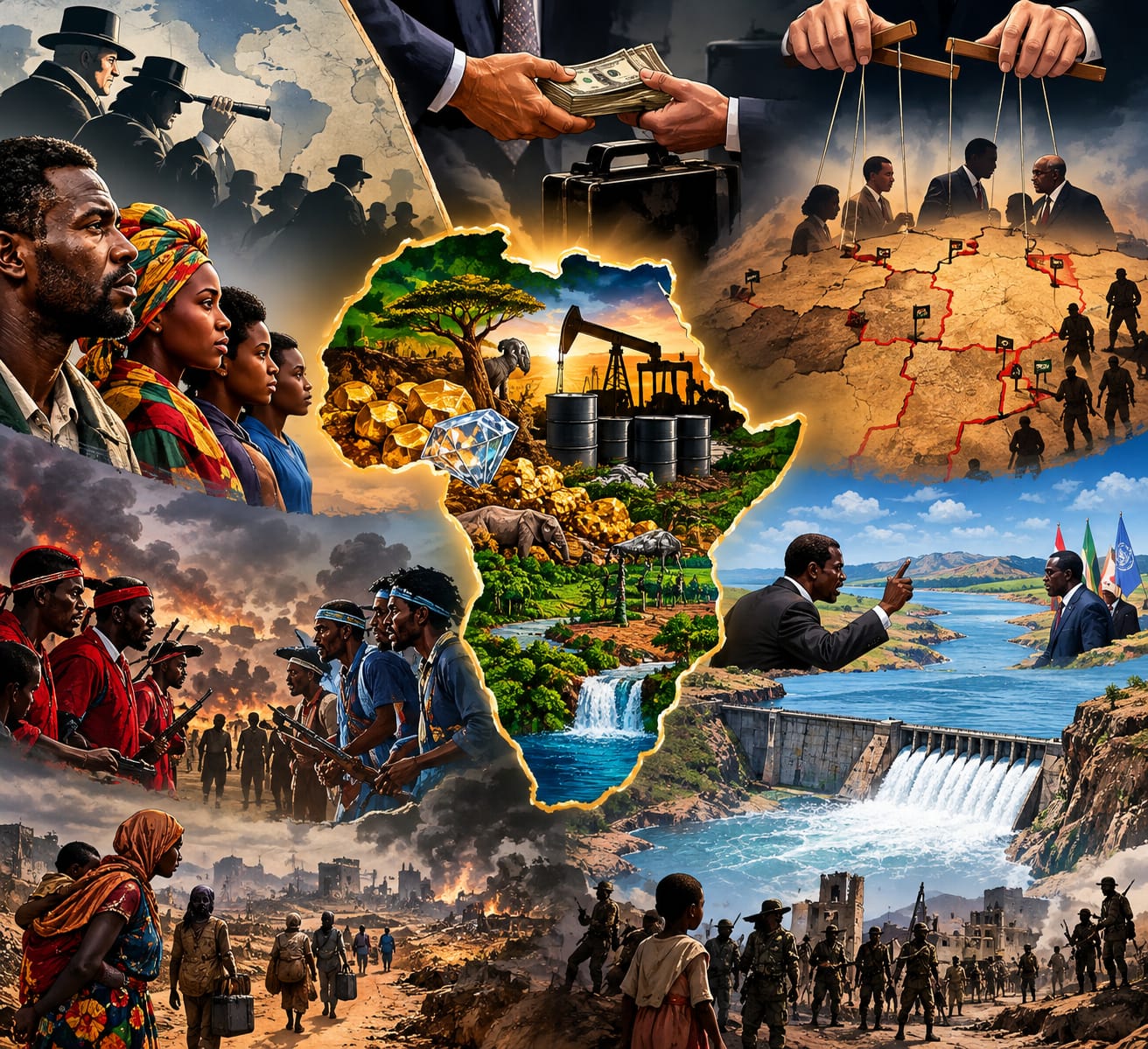
For nearly five days, I have been trying to enter the thorny African file in search of substantial information that could help me write an article for your esteemed and important publication. Yet I found myself suddenly in the middle of an endless sea of shifting sands, whose contours change from one day to the next, causing the compass that might guide me toward a shore where I could safely anchor to disappear.
No African is unaware of the complexity of the circumstances surrounding one of the world's richest continents in terms of natural resources, even though its people remain among the poorest in terms of living standards.
Although the African continent has apparently freed itself from the grip of colonialism that plundered its wealth, it continues to suffer from corruption, which remains one of the most prominent features of many of its countries.
And since we have mentioned corruption, we must acknowledge the role played by corrupt actors who serve as agents of colonialism. Colonialism may have formally departed, but it has remained through its corrupt proxies and through the border disputes it deliberately left behind, allowing them to fuel seemingly endless conflicts among brothers and fellow citizens of the same continent.
The intrigues of the colonial powers did not stop at creating and inflaming border disputes. They went further, stoking national, tribal, ethnic, and even color-based divisions, among other conflicts.
In addition to all of the above, water disputes have emerged between countries where rivers originate and those downstream, particularly with the emergence of a tendency among some upstream states to regard rivers as their private property, contrary to international laws and norms. This has been accompanied by their rejection of agreements and treaties concluded in previous eras, recognizing them only when they serve their own interests—as in the case of the Ethiopian dam, along with threats to construct additional dams. Such developments could plunge the African continent into a devastating and potentially endless war.
This is not to mention the civil wars that have afflicted the continent. Many of us may still remember the tragedy of the brutal conflict between the Hutu and Tutsi, fought among people of the same country.
The tragedies of Africa did not stop there. More recently, we have been surprised by the insistence of some African countries on entering the game of nations and international rivalries by aligning themselves with colonial powers from outside the continent, in an effort to pressure and exploit their fellow Africans.
A clear example, in the author's view, is Ethiopia's insistence on obtaining, by force, access to a port on the Red Sea, despite not being a littoral state of that sea. Here, one cannot overlook Ethiopia's alliances with major international powers, as well as regional Asian powers that are known for what the author describes as colonial practices and racist policies, including accusations of genocide, or powers regarded by parts of the international community as rogue states.
All of this, according to this argument, is aimed at pressuring fellow African countries instead of pursuing integration and cooperation among the continent's own nations.
As conflict among African states has intensified, competition among major powers seeking their own interests has also emerged. At the forefront are the United States, China, Russia, and Britain, which is seeking a share of the legacy of its former colonial possessions, while France is facing the erosion of its influence in favor of Russia and the United States.
Nor does the matter end there. Regional powers have emerged, each pursuing its own interests, including Saudi Arabia's interests in the Red Sea and the competing forces in Yemen on the Asian side of the strategically vital Bab el-Mandeb Strait.
If we acknowledge that Saudi Arabia and Yemen have direct interests because they are littoral states bordering the Red Sea and Bab el-Mandeb, the situation is different with other countries that have their own interests, alliances, and ambitions and are alleged to be playing a functional role—even though they are Asian countries geographically distant from Africa and its affairs.
These include the United Arab Emirates, and at times Qatar, as well as Iran, which has recently entered the arena after previously relying on its affiliated forces to appear on the front line.
According to the author, the UAE has already become involved, as alleged in United Nations reports, in armed conflicts and in the transfer of weapons and mercenaries to support the Rapid Support Forces (RSF). Ethiopia, meanwhile, has faced civil conflict involving the Tigray ethnic group and the Fano forces associated with the Amhara community, which recently captured a contingent of the Ethiopian army and seized its weapons after inflicting what the author describes as a major defeat.
An observer of the situation may find that African countries such as Egypt, Sudan, and Somalia have grounds for disagreements with Ethiopia for several reasons, foremost among them water issues, Ethiopia's recognition of Somaliland, and the forces seeking to divide Somalia.
All these disagreements can be resolved through negotiations among brothers, provided that genuine goodwill exists.
The same applies to the dispute over the Red Sea involving Egypt, Saudi Arabia, and Yemen, despite what the author describes as the irrational and unjustified insistence on escalation by the government of Abiy Ahmed in Ethiopia.
The solution to all of Africa's problems may appear distant, perhaps even impossible, because of the intervention of international and regional great powers. Yet the practical solution, in the author's view, lies halfway in an agreement among African states to keep all external powers from interfering in the continent's affairs.
The other half lies in placing the interests of African countries and peoples above rivalry, seeking points of understanding, agreement, and cooperation among them, and working for the benefit of the continent's peoples—to secure for them a place under the sun and a decent, prosperous life, rather than leaving them to perish in boats of death while attempting irregular migration across the seas.
Comments
