04Oct
As the world heads to COP31 in Antalya, Türkiye, a new financial frontier is reshaping climate action: carbon finance. With global carbon markets now valued at nearly $890 billion, nations are racing to turn emission cuts into investable assets. Ghana is seizing that moment. Having just joined the Coalition to Grow Carbon Markets alongside Türkiye and Luxembourg in August, the West African nation is positioning to unlock billions for clean cooking, forests and renewable energy. But can Ghana scale fast while ensuring integrity and avoiding greenwashing? West Africa Bureau Editor Dela Ahiawor examines how Ghana is aligning local ambition with this global strategy.
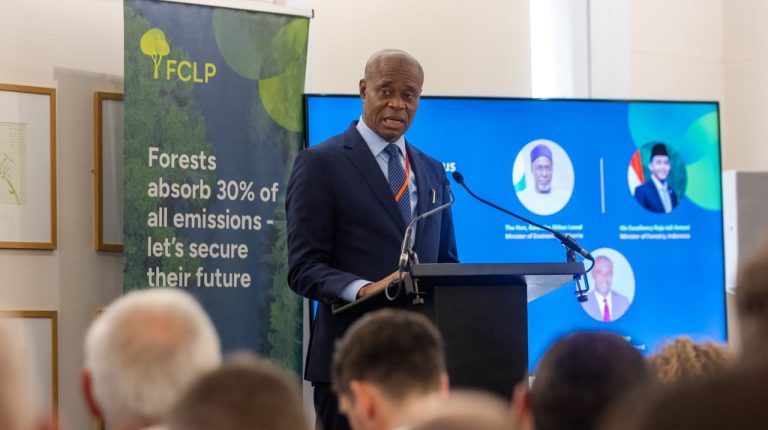
Hon. Ahaji Yusif Sulemana, Ghana's Deputy Minister for Lands and Natural Resources
The race to stop the catastrophic climate change is on. To fund this, global investments designed to fund initiatives that help to reduce or extract greenhouse gas emissions -- known as carbon finance-- are surging.
Consequently, this has led to the growth of global carbon markets valued at nearly, $890 billion, aiming to monetize greenhouse gas reductions into tradable financial instruments (assets).
In 2025, a government-backed global initiative, The Coalition to Grow Carbon Markets was established to help scale voluntary corporate demand for high-integrity carbon credits, in the bid to finance clean energy and forest conservation initiatives to compensate for their carbon footprint. Building on this progress, Ghana, Luxembourg and COP 31 host Türkiye joined the Coalition to Grow Carbon Markets in August, bringing the total number of member governments to 14.In view of this, joining the Coalition to Grow Carbon Markets is timely for Ghana, as the country is already experiencing severe impacts, including rising temperatures, shifting rainfall and rising sea levels.
The Coalition to Grow Carbon Market initiative stands to help new members like, Ghana to unlock billions to drive, sustainable development.
Specifically, the coalition, was formed to strengthen corporate demand for high-integrity carbon credits, accelerating a market capable of unlocking more than USD$50 billion in additional finance for climate action annually by 2030. With such massive financial potential, carbon finance discussions are key for the Coalition to Grow Carbon Markets.The upcoming UN Climate Change Conference (COP31) to be held in Antalya, Türkiye, from November 9 to 20, 2026 will set the stage for key negotiations on climate finance. Definitely, Türkiye’s membership of The Coalition to Grow Carbon Market adds significant momentum to the initiative.
In anticipation of the COP 31 negotiations, African countries are actively positioning themselves, with Ghana becoming the third African member country after Kenya and Zambia to join the Coalition in August 2026. Indeed, Africa is rapidly embracing carbon markets, aiming to scale investment in local carbon finance projects. Besides, they are also ensuring authentic emission reductions (market integrity) in a bid to avoid greenwashing.
To this end, the government of Ghana finances carbon projects: clean cooking, renewable energy and forest conservation through state, global, and community-level resources.The main initiatives funding climate action in Ghana include: Green Climate Fund (GCF) Grants: In September 2026, the government secured a $7 million grant from the Green Climate Fund (GCF) to enhance agricultural endurance and early warning networks across eight districts in the Northern part of Ghana.
Nordic Development Fund (NDF): In July 2026, €11 million was approved to expand community infrastructure and locally led climate initiatives across 48 districts under the SOCO Ghana project.Local Climate Adaptive Living Facility (LoCAL):Allocated over $1 million via the UNCDF to support localized climate-resilient projects, including irrigation dams and sustainable waste composting.
Climate Prosperity Plan (CPP): Endorsed a new investment framework in April 2026 to secure public and private capital for sustainable growth.National Institutional Support: Ghana's Ministry of Finance Climate Financing Division actively lowers risks for green projects and helps prepare a strong pipeline of future initiatives.Indeed, climate finance investments in local carbon projects are actively helping Ghana achieve measurable greenhouse gas emission reductions while driving sustainable development. Notably, Ghana has made remarkable progress this includes: Emissions Reductions: Ghana has authorized millions of tonnes of CO₂ equivalent via Internationally Transferred Mitigation Outcomes (ITMOs) and jurisdictional carbon programs like sustainable cocoa-forest initiatives.
Sector Expansion: Projects span clean cooking, renewable energy, electric mobility, agriculture, and waste management.Strategic Frameworks: Partnerships under Paris Agreement Article 6 (with nations like Switzerland, Sweden, and Singapore) and frameworks like the Ghana Carbon Registry ensure environmental integrity and transparent benefit-sharing.Building on these foundational standards, Ghana's Deputy Minister for Lands and Natural Resources, Hon. Yusif Sulemana MP, in his remarks after Ghana joined the Coalition to Grow Carbon Markets in August said: “Our focus now is on scaling investment in carbon finance projects in Ghana. Integrity in the carbon market regime is critical to avoid green washing. Projects must achieve actual emission reductions, and this I should say must also be complemented with sustainable carbon pricing." Ghana views the Coalition to Grow Carbon Markets as a vital platform for addressing these two critical issues. We are proud to join this coalition and will collaborate closely with member governments to achieve our goals.
For his part, Murat Kurum, Minister of Environment, Urbanization and Climate Change, and President of the 2026 United Nations Climate Change Conference, COP31 added that: “To achieve our global climate and sustainable development goals, coordinated leadership among countries to unlock the potential of carbon credit markets is essential." Although underutilized, carbon credit markets are essential for climate action; Türkiye is therefore joining the Coalition to Grow Carbon Markets to clarify corporate rules and drive global emission cuts.
By leveraging these standards, maximizing carbon credit markets at COP31 will support the Presidency's goals for electrification and the clean energy transition.
Reliable, high-quality carbon credits serve as a vital tool for industry transformation, funding the shift to renewable energy while tackling emissions from sectors that cannot yet be electrified.Aligning with this global strategy, by joining the Coalition to Grow Carbon Markets, Ghana is boosting global efforts for government-backed carbon finance initiatives, which are key to attracting private investment for sustainable development, forest conservation and inspiring greater awareness for climate change.
Comments
