13Aug
By Michael Adeboboye
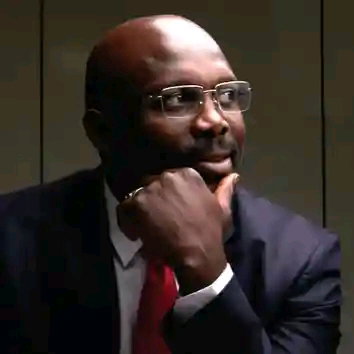
Former Liberia's President George M. Weah on a comeback bid come 2029
Daniel Sando’s claim on the maiden edition of The People's View on Punch FM that George Weah “never understood the magnitude of the presidency” and that “no country will jeopardize their affairs by inviting Weah” sounds more like political taunting than analysis. It reduces a complex presidency and a complex post-presidency to one metric: who gets invited to AU mediation rooms right now.
That metric is flawed.
First, the idea that Weah is “less busy” because he is not on every continental panel misses the point of what he has chosen to do since January 2024. He conceded defeat peacefully, handed over power, and went straight back to rebuilding the Congress for Democratic Change as Standard Bearer. In a region where losers contest results or disappear, that act itself is statesmanship. He has spent the last 18 months touring the 15 counties, holding town halls, reorganizing party structures, and positioning the CDC for 2029. That is not idleness. That is opposition politics in a democracy. Ellen Johnson Sirleaf took a global appointment route. Weah took a domestic rebuilding route. Both are valid expressions of post-presidency relevance.
Second, to say he “never understood” the presidency ignores the policy footprint he left between 2018 and 2024. Weah came in at the tail end of Ebola, with a battered economy and a public sector drowning in debt.
His administration made the call to abolish tuition fees at all public universities and colleges, putting thousands of young Liberians back in classrooms who had dropped out over cost. On infrastructure, the record is visible.
The government delivered major road works, including pavement on the Coastal Highway, and the Sanniquellie to Loguatuo road that opened up Nimba and connected farmers to markets. That was more kilometers of paved road than Liberia saw in the prior decade.
On security and gender, he declared rape a national emergency in 2020 and backed it with the establishment of a dedicated SGBV Crimes Unit and a special court. During COVID-19, Liberia avoided the mass lockdown collapses seen elsewhere, keeping markets open while rolling out testing and treatment centers with donor support. Were there failures? Yes. Inflation bit hard, corruption allegations dogged appointees, and youth unemployment remained stubborn. But governance is not a pass-fail of perfection. It is about choices under pressure, and Weah made choices that directly touched education, roads, and public health.
Third, the argument that “no one will call Weah to negotiate” assumes that mediation is the only proof of capacity. It is not. Weah’s international brand was built differently. As a former FIFA World Player of the Year, he carried a unique form of soft power. The African Union named him Peace Ambassador in 2018. FIFA and the UN used him in campaigns against drugs and violence targeting African youth. That is diplomacy, just not the closed-door kind Sando seems to prefer. Countries don’t invite former leaders to mediate because they are free. They invite them because they hold current institutional mandates. Sirleaf holds those now through various boards and elder roles. Weah holds a political mandate at home. If the CDC returns to power in 2029, watch how fast those same phone calls Sando says will never come start coming.
And that is the core of the 2029 argument. Weah is running again precisely because he believes the first term was interrupted, not concluded. His pitch to Liberians will not be about AU panels. It will be about unfinished business. He will point to the foundation laid: tuition-free policy that can be expanded, road connectivity that can be completed to the borders, and the Pro-Poor Agenda for Prosperity and Development that was cut short. He will argue that a second term with experience, without the learning curve of 2018, is what Liberia needs to convert projects into outcomes.
Politically, he still commands the largest single party structure in the country. The CDC remains organized in every county. His base among youth, marketers, and communities outside Monrovia did not vanish in 2023. They stayed, and they are the reason he is already campaigning. In African politics, name recognition, party machinery, and a story of “we started something, let us finish it” are powerful assets. Weah has all three.
Sando’s jab that “everyone knows he doesn’t have that ability” is really a statement about preference, not fact. Liberians will decide in 2029 whether they prefer Sirleaf’s technocratic, global-network model or Weah’s populist, grassroots, infrastructure-first model. Both have governed. Both have records to defend.
To dismiss Weah now as incapable is to ignore history. He went from footballer to senator to president. He left power peacefully. He is rebuilding a party. He is still the most recognizable Liberian on the planet. That is capacity.
The question for 2029 will not be whether other countries are calling him today. The question will be whether Liberians believe he understood the presidency enough to be trusted with it again.
If they do, then the invitations Sando talks about will follow the office, not the man.
Because in politics, relevance follows power. And Weah is betting everything that power is coming back in 2029
Comments
