03Oct
By Dr. Ashraf Aboul-Yazid
What does Moscow whisper to a traveler who listens from the sky? In this exclusive travelogue for CAJ International Magazine October 2026, celebrated Egyptian poet, novelist and Silk Road Literature Series Editor Dr. Ashraf Aboul-Yazid takes us beyond Red Square into Seven Muscovite Tales. From Stalin's Seven Sisters piercing the skyline to the tears of crystal in the Victory Museum, from Russian Cosmism memory to the Second World Public Assembly on values that unite us, his journey is more than sightseeing. It is friendship along the Silk Road, awards crossing borders from Beijing to Cairo, and a family reunion after twelve years on the Moskva River. A poetic dispatch where architecture, war memory, philosophy and love meet.
Every city has its own stories, and not all of them are told in books. Some hide in narrow alleys; others float upon the surface of rivers. Some dwell in squares, bridges, and domes. Moscow, however, knows how to tell some of its secrets from the sky, where its towers rise like enormous pages in an open book of the city’s history.
The First Tale:
Stalin’s Seven Sisters In Moscow, it is not enough to contemplate the Kremlin or stand in Red Square, nor simply to follow the course of the Moskva River or walk in the footsteps of visitors through the historic heart of the city. Above the urban landscape rise seven towering buildings that command the eye, appearing like landmarks etched into Moscow’s memory. They are known as the “Seven Sisters,” or, in Russian, Stalinskiye Vysotki—the “Stalinist skyscrapers.” Together, they have become one of the most distinctive features of Moscow’s architectural identity.Most of these monumental structures were built between 1947 and 1957, during the final years of the Stalin era. Yet they were never merely skyscrapers in the engineering sense. They were architectural statements written vertically across the Moscow skyline.From a distance, their form resembles a theatrical scene. Each building rises from a broad and powerful base, then ascends through successive tiers that gradually narrow until they reach a slender spire pointing toward the heavens.
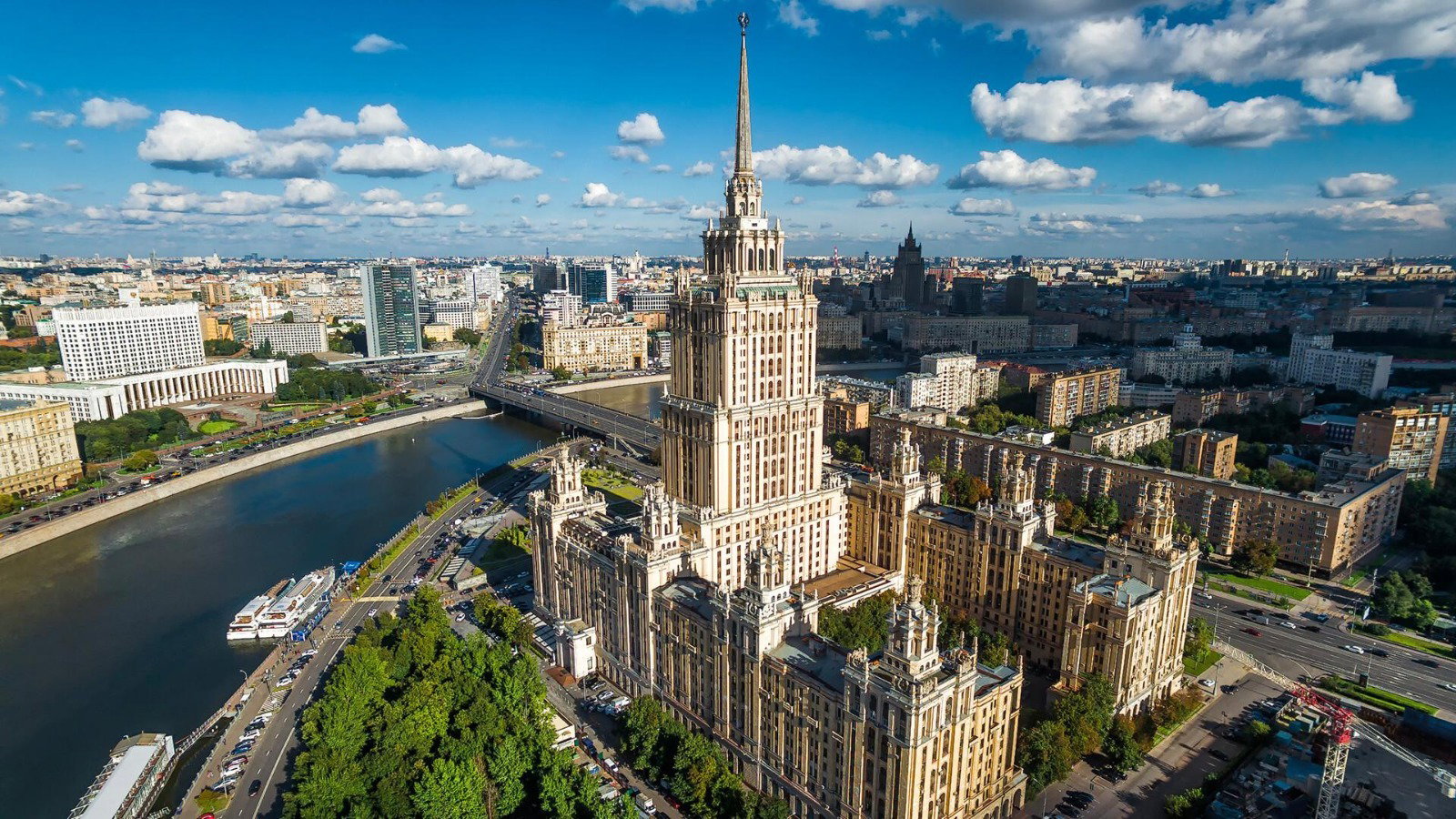
Moscow State University as seen from the Moskva River.
At the summit, the famous star appears like the final punctuation mark at the end of a sentence written by the city upon the page of the sky. It is difficult to place this architectural style in a single category. It borrows the grandeur of classical architecture, the richness of Russian ornamentation, echoes of the Baroque, and the soaring ambition of Gothic architecture, while embracing the engineering possibilities made possible by the modern skyscraper. The result belongs neither entirely to the past nor entirely to modernity, but represents a distinctive twentieth-century vision of monumentality and grandeur. Perhaps this is what makes the Seven Sisters so captivating to a traveler: they are buildings, but they are also historical documents standing upon the earth. The largest of the Seven Sisters, and perhaps the most dramatic in its setting, is the main building of Moscow State University, standing atop Sparrow Hills. Its enormous central tower dominates the surrounding landscape, while its long wings extend symmetrically on either side, almost evoking the image of a palace.
Looking at it, one understands how architecture can transform education into a majestic civic symbol. Here, the university does not merely occupy a space within the city; it seems to enter into a dialogue with Moscow from above. Near the Moskva River stands the Kotelnicheskaya Embankment Building, whose location gives it a particular poetic quality. As we travelled on a river cruise, it seemed as though the river flowed beneath it while its tower rose above the old city. From the water, or from the opposite bank, the building appears to belong simultaneously to two worlds: historic Moscow, with its streets and churches, and the monumental architectural vision of the twentieth century. Then comes the Hotel Ukraina, now known as the Radisson Collection Hotel, Moscow. Its location near the Moskva River and Kutuzovsky Prospekt gives it a character of its own. Built as a grand hotel, it nevertheless carries the same vocabulary of strength and celebration that distinguishes its sisters. The hotel was designed to receive guests, yet the building itself became part of Moscow’s welcome to its visitors—a lofty gateway into the city, leaving a memory no less powerful than the images of its streets and squares. The Ministry of Foreign Affairs building may be the most unmistakably official of the Seven Sisters. Standing on Smolenskaya Square, it seems designed to announce, even before any diplomat speaks, the importance of the institution.
The Second Tale:
The Victory Museum We set out for the Victory Museum, officially known as the Central Museum of the Great Patriotic War. Our guide, Miss Sin, was waiting for us, ready to lead us through the museum’s galleries as though she carried history in her hands, a lamp whose flame never dies. Our journey began beneath the vast dome, where a film about the war unfolded like a wound being illuminated once again: aircraft screaming across a trembling sky, soldiers swallowed by snow, and cities rising from the rubble like prayers that refused to die. I began taking photographs of the dome, but I found myself missing a video camera. Still images could hardly convey what surrounded us in that Russian-language film. Yet somehow, we understood it. From there, we entered the Hall of Memory and Sorrow, where crystal tears hung in silent eternity, as though grief itself were suspended in the air like a faint incense.
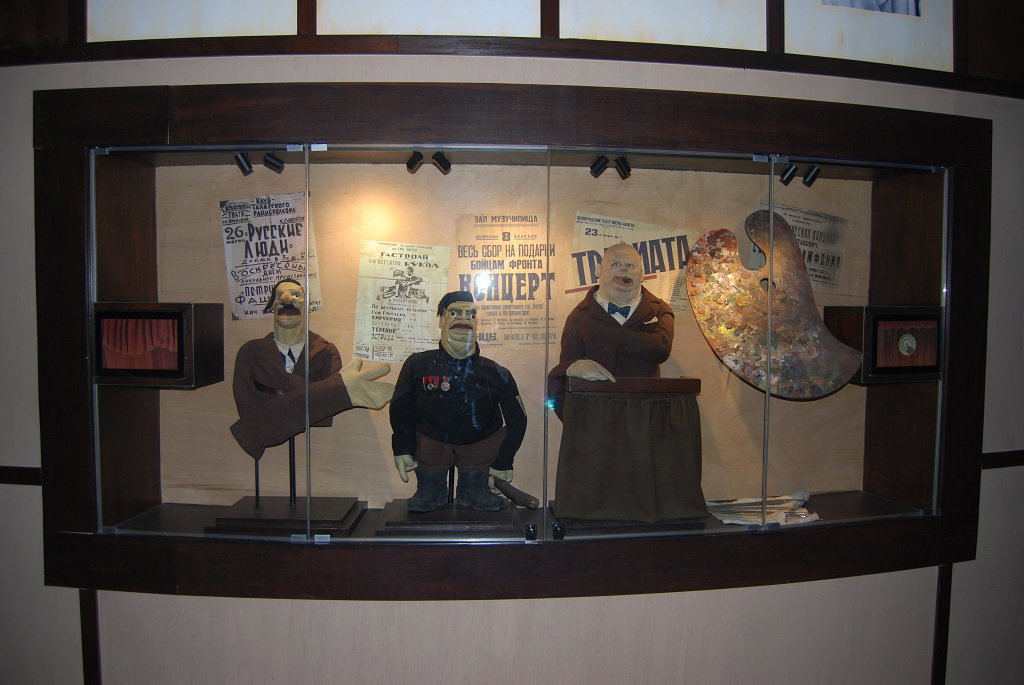
Mocking the enemies with puppets on the screen
Then came the Hall of Glory, where marble columns rose like ranks of soldiers, and a weary yet triumphant bronze soldier stood as a reminder that victory itself is never entirely free of trembling. We then climbed to the Hall of Military Commanders, where bronze faces seemed to stare at us, almost as if testing our courage. Our journey continued through rooms in which letters and diaries seemed to have fallen asleep in time, alongside the worn suitcase of Zhukov, all breathing truth from behind yellowed pages. Inside the Arteries of the Museum, every corner seemed alive: the frozen trenches of Moscow, the burning factories of Stalingrad, the fragile hunger of Leningrad, the thunder of Kursk, the flames along the Dnieper, and the exhausted twilight of Berlin. Each scene was a poem carved from suffering and determination. We entered the lives of ordinary people during wartime: a loaf of bread measured in terms of survival; a besieged library; a workshop almost resounding with the heartbeat of its workers; children’s drawings glowing with hope despite the darkness of the siege. We wandered through the museum’s arteries like drops of blood in flight, while history pulsed through the corridors in the murmurs of a nation that had crossed the ordeal. With Sin’s calm certainty guiding us, we descended into its depths, beginning with the Hall of Historical Events, where illuminated maps unfolded like ancient chronicles, tracing the changing lines of battle like scars opening and healing upon the body of Europe. The light from the maps fell across our faces. My own face seemed to echo distant wars on the banks of the Nile. Before we climbed into one of the vehicles used to transport refugees, we saw a woman wandering through the scene, sitting from time to time on a makeshift seat fashioned from a discarded wooden crate. Beside her lay two piles of books. Saving books, I thought, is as important as saving human beings. I sat there for a while before joining the group inside the vehicle. Sin then asked us: How many people could this vehicle hold? After a visual estimate, I answered, “Thirty.” Yet fleeing the field of fire meant carrying as many people as possible in a single vehicle. They travelled standing, unable even to rest during that exhausting journey. The Holograms of the Commanders Through a glass window, we watched a Russian command room during the battle, with holographic figures moving inside it as though the dead had been brought back to life. The dark room was dominated by a large map spread across a table, around which senior Soviet commanders were seated. Joseph Sta
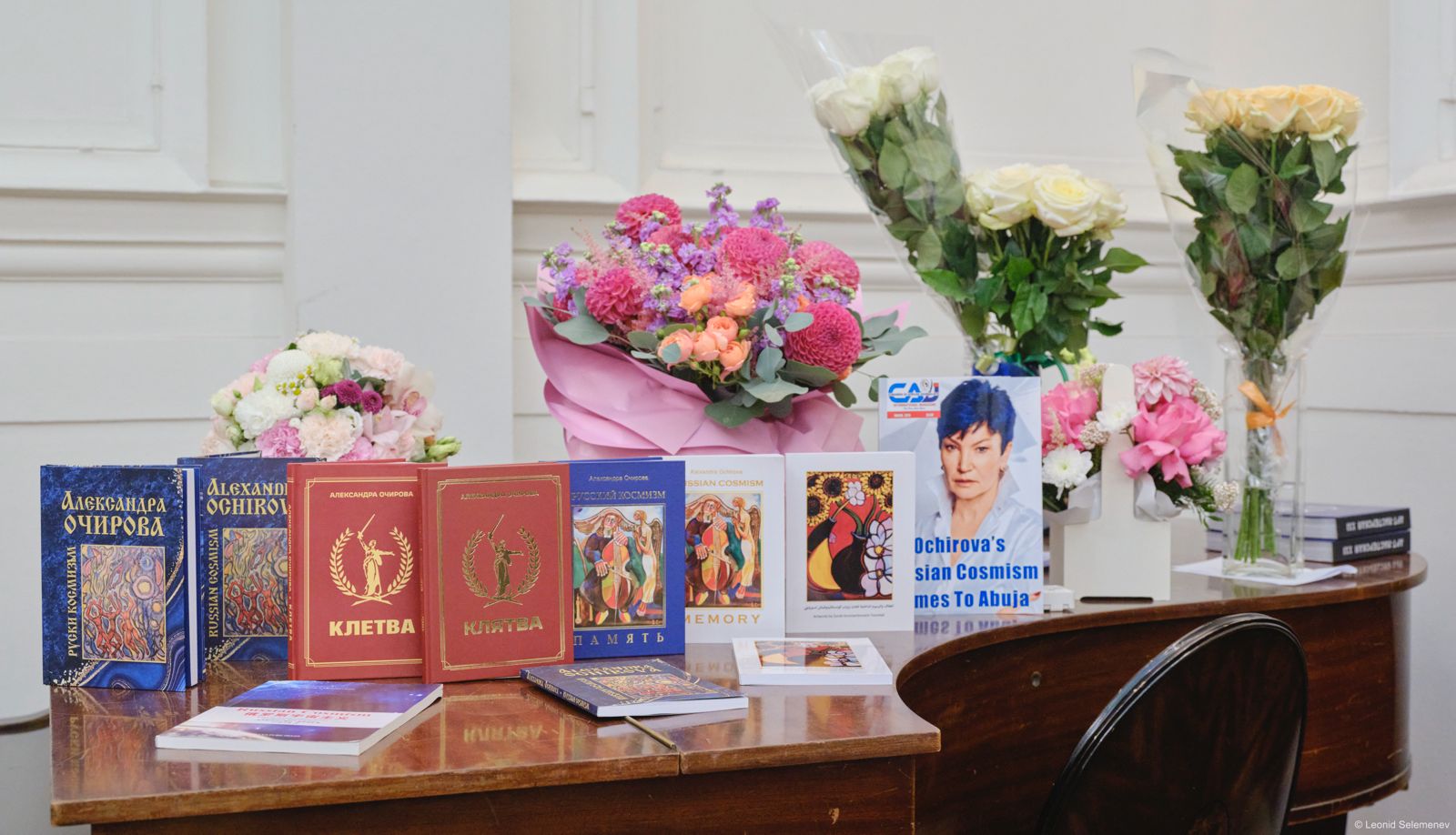
The Russian Cosmism series in Russian, English, Chinese, and Arabic, along with CAJ International Magazine exhibited at the ceremony
The Third Tale:
Russian Cosmism… Memory One of the richest tales of this journey was the celebration of the latest book in the Silk Road Literature Series: the new philosophical poetry collection Russian Cosmism… Memory by the distinguished Russian poet, philosopher, and thinker Dr. Alexandra Ochirova.
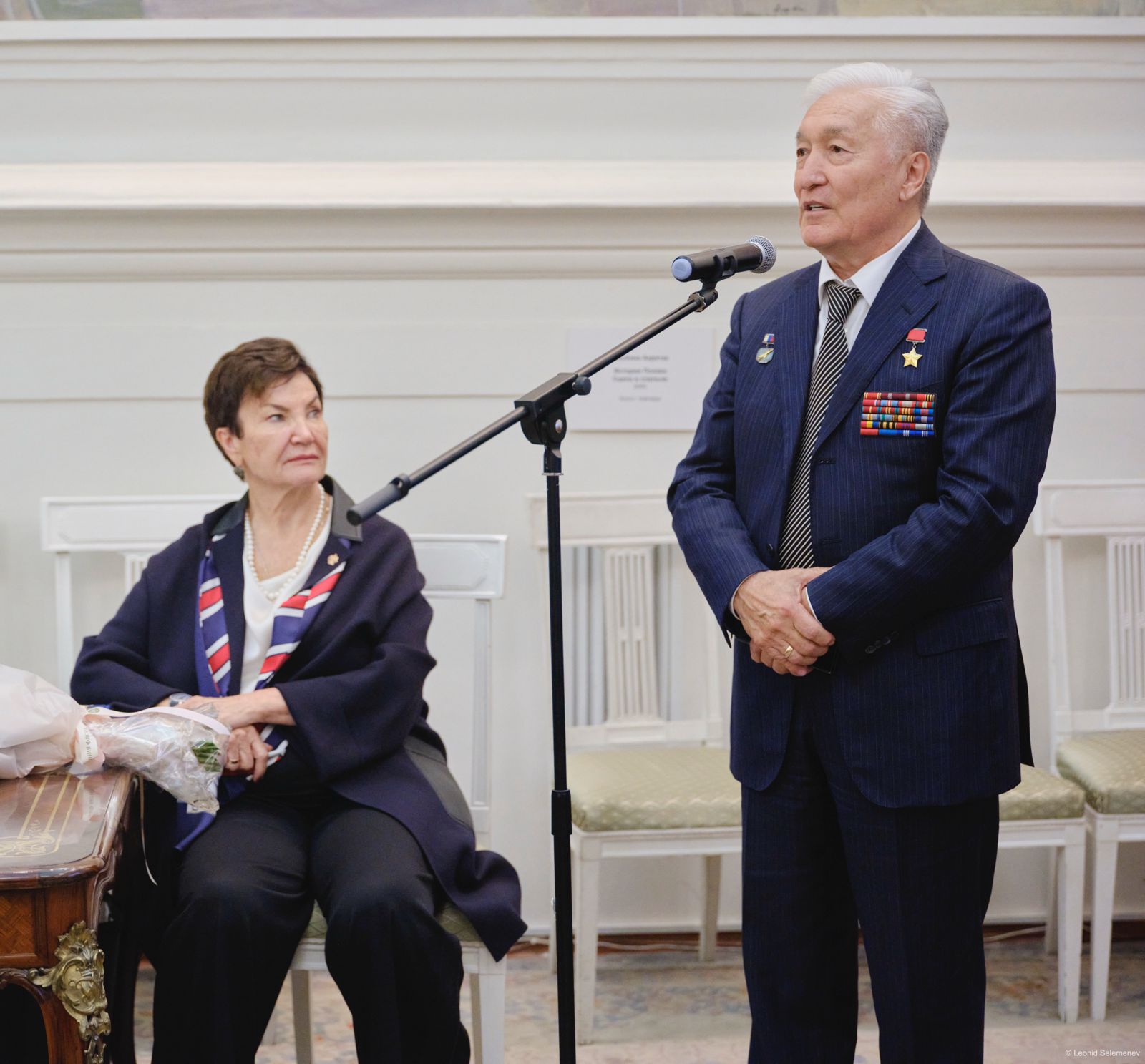
National hero and pilot Valery Ocharov delivers a speech at the launch ceremony of his wife, poet Dr. Alexandra’s book, Russian Cosmism: Memory, at the Academy of Arts
The book has been published in two editions, Arabic, in my translation, and English, continuing the intellectual and poetic project she began with her earlier volume, Russian Cosmism. In this new work, Ochirova adds another profound dimension to her vision, placing memory at the heart of human existence and presenting it as one of the foundations upon which civilization and the written word endure. Both editions were published by Al-Nasher Publishing House in elegant volumes enriched with the works of the internationally acclaimed artist Zurab Tsereteli.Ochirova does not approach memory merely as an act of recalling the past, or as nostalgia for what has disappeared. She sees it as an ontological force, one that gives human beings an awareness of themselves and of their place in the universe. In this collection, memory preserves the identity of peoples, connects generations to one another, and gives civilization continuity despite the transformations of history.From this perspective, Russian Cosmism transcends its geographical boundaries and becomes a comprehensive human vision, searching for humanity’s shared destiny through poetry and thought.The new edition acquires an exceptional artistic dimension through its dedication to the memory of Zurab Tsereteli, whose friendship with the poet extended over nearly four decades. The selected works of visual art do not serve merely as illustrations or decoration; they enter into a philosophical dialogue with the poems themselves. Thus, word and image inhabit a single aesthetic space, each illuminating the other and revealing new layers of meaning.
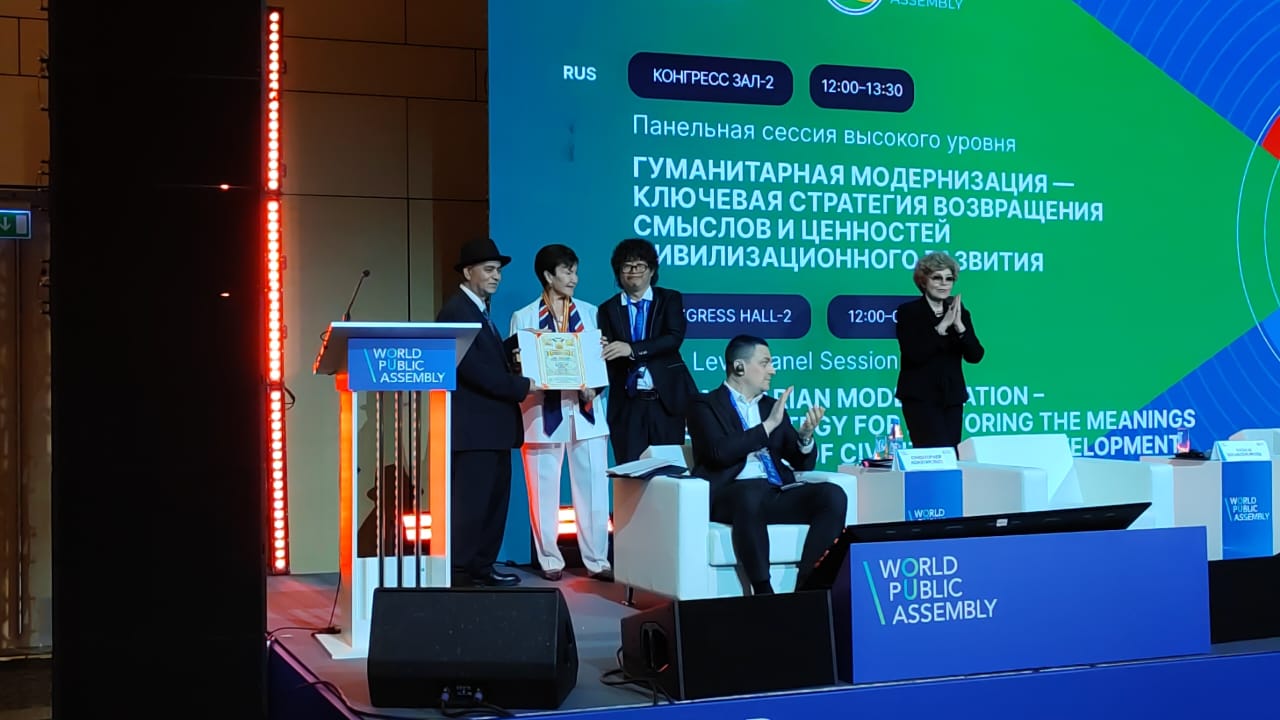
The Great Poetry Movement Medal and the Hong Kong Literature and Arts Award for Russian poet Alexandra Ochirova.
The book becomes, therefore, a complete artistic experience in which poetry and visual art meet, converse, and deepen one another. This volume represents a natural continuation of Russian Cosmism, in which Ochirova presented cosmism as a bridge connecting poetry, philosophy, science, ethics, and humanity’s shared heritage. Russian Cosmism… Memory, however, introduces a deeper question into that journey: What must humanity remember in order to continue its journey toward the future? Alexandra Ochirova’s poetry affirms that civilizations do not survive through power alone, but through memory, dialogue, creative imagination, and literature’s ability to preserve the spiritual heritage of humanity. At a time when the world is searching for shared values capable of transcending political and cultural divisions, Russian Cosmism… Memory arrives as a profound poetic meditation on the unity of humankind and the diversity of its civilizations. It reminds us that literature remains one of the greبالطبع. سأحافظ على النبرة الأدبية التأملية التي اتبعناها في الحكايات السابقة، مع صياغة إنجليزية طبيعية تصلح لسلسلة Seven Muscovite Tales، لا ترجمة حرفية جامدة.
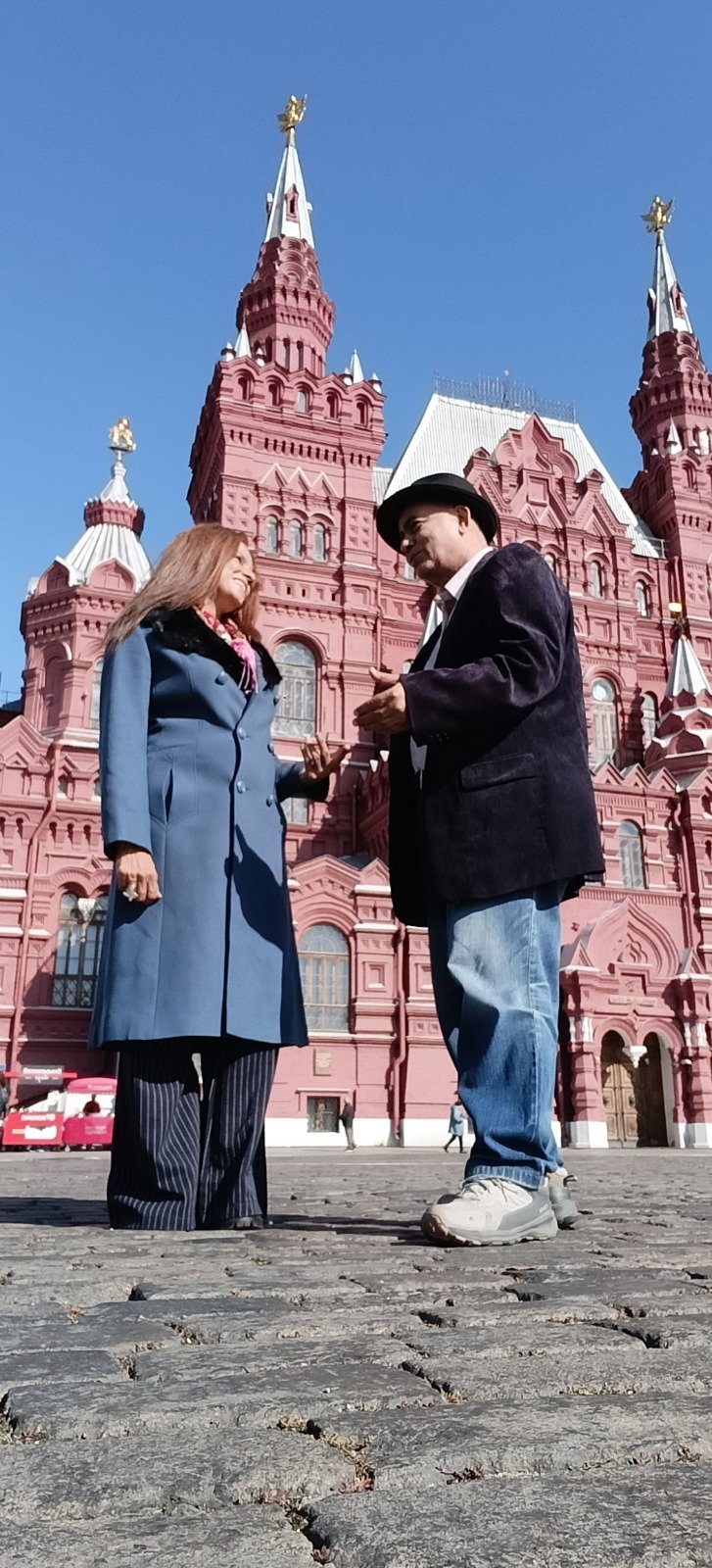
The writer and his wife in Red Square, Moscow, September 2026.
The Fourth Tale:
The Values That Unite Us.
Since we have mentioned values, let us turn to the most important event that brought us together in Moscow during the third week of September 2026: the Second World Public Assembly, held under the theme “The Values That Unite Us.”The declared values that illuminate its programs stem from the conviction that unity in diversity is the foundation of human coexistence, with all that this implies in terms of deep respect for cultures, religions, traditions, and their differences. The Assembly believes in conscious partnership, based on voluntary cooperation and the convergence of shared values. It also regards humanistic modernization as a path toward strengthening cooperation through culture, education, and science, and embraces openness as a commitment to transparency in action and to shared development for the future.
This system of values is completed by responsibility: awareness of the consequences of our actions and a willingness to be accountable for them before society and future generations. It was from this foundation that participants engaged in seminars, discussion sessions, working groups, and round tables. On 18 September 2026, the World Trade Center in Moscow hosted a dialogue session entitled “Values and Principles of Positive Life-Construction: Intersection of Universes,” as part of the Second World Public Assembly, “New World: Values That Unite,” held in Moscow on September 18 and 19.
The session was moderated by Andrey Yavny, Adviser to the Chairman of the General Council of the World Public Assembly and holder of a PhD in Philosophical Sciences. It brought together voices and experiences from different fields and cultures, seeking to approach a human question that transcends borders: How can a person build a life upon the firm ground of values in a rapidly changing world, where information competes for our attention, reference points are constantly shifting, and the need for meaning becomes ever more urgent?
The session brought together Alexandra Ochirova of Russia, Co-Chair of the Supreme Advisory Council of the World Public Assembly and a UNESCO Goodwill Ambassador; Timuraz Batiashvili of Georgia, businessman and Candidate of Economic Sciences; Ekaterina Velishkina of Russia, public activist and blogger; Irina Umarova of Moldova, psychologist specializing in existential crises; Ashraf Aboul-Yazid Dali of Egypt, poet, writer, Editor-in-Chief of the Silk Road Literature Series, and President of the Asian Journalists Association; and Fatma Elzahraa Hassan of Egypt, television director and screenwriter. The subject of the session, “Values and Principles of Positive Life-Construction,” came at a moment when humanity is confronting a world of accelerating transformation, widening circles of uncertainty, and an accumulation of information so immense that an individual may lose the compass within. The conversation therefore began with a question that was at once simple and profound: How do we build our lives—not according to an ideal blueprint drawn for the next ten years, nor according to the polished image of success manufactured by media narratives, but through the quiet daily work of preserving meaning?
In this context, Alexandra Ochirova emphasized that building a life does not mean possessing a perfect plan for the future, but rather retaining a sense of meaning in a world that changes rapidly. She said that it is about the ability to hear one’s inner voice amid a torrent of contradictory signals—the voice that tells a person: “This belongs to me; this I will not betray; this I will protect. ”Drawing on her experience with UNESCO, Ochirova noted that culture, education, and intercultural dialogue are not merely fields of human activity.
At their core, they constitute an infrastructure of resilience. They provide people with a source of strength that goes beyond the race of consumption and help them preserve their sense of self when they are surrounded by external messages urging them to buy, imitate others, and chase every new trend. Among the practical tools Ochirova employs is what she calls a “heritage map.” It is not limited to monuments and historic buildings, but extends to intangible heritage: family stories, local traditions, personal memories, and even everyday rituals that we may practice without pausing to consider their meaning. When a person discovers how many layers of meaning are already rooted in his or her life, it becomes easier to distinguish between what has been imposed from outside and what truly belongs to the self. And this, she said, is where the construction of life begins: with one dialogue, one story, one conscious act.
From these small acts, a more stable vision of life gradually takes shape. Yet no human being can enclose himself within individual boundaries, because the construction of an individual life always takes place within a wider system: society, culture, and civilization. Human questions must therefore be viewed as global questions connected to the preservation of our humanity, while one of the keys to the security of development lies within the human sphere itself. Ochirova recalled the famous saying attributed to Socrates: “Know yourself, and you will know the whole world.” From this principle, she observed, humanity has built science, culture, art, traditions, and values. She also pointed to the structural contradiction confronting a one-dimensional model of governance in a world of extraordinary complexity and diversity.
The complexity of governance, she argued, should not be inferior to the complexity of the world it seeks to govern. This led to the need for the modernization of the humanistic sphere—the creation of a new human space in which respect for the human being becomes a genuine principle guiding individual development and protecting all cultures and peoples. In her vision, the ethical, understanding, and responsible human being is the guarantor of the continuity of human life and of a civilization with a human face. This is why dialogue platforms grounded in knowledge and evidence acquire particular importance: they help build an infrastructure for strategic thinking and make it possible to transform global risks and contradictions into development priorities. At the conclusion of her intervention, Ochirova articulated the central idea of the session: “the intersection of universes” ceases to be merely a beautiful metaphor when culture, science, politics, and everyday life begin to speak a shared language of meaning.
When every human being, drawing upon his or her heritage and values, is able to construct life consciously, that individual is simultaneously participating in the construction of a more sustainable and just civilization. Timuraz Batiashvili continued this line of thought from the perspective of economics and business. Values, he observed, are not what we proclaim with our words, but what we rely upon when making decisions. In the world of business, a strategy grounded in values is therefore more closely connected to sustainability than simply entering an open-ended race for profit. Ekaterina Velishkina, meanwhile, addressed the role of the media in shaping the contours of the life people aspire to lead. Today, she noted, media do not merely set the public agenda; they also contribute to shaping people’s perceptions of what constitutes a “right life. ”This places a responsibility upon media narratives—not to impose glamorous models of success, but to reveal the diversity of the real strategies through which human beings live their lives.
From the perspective of psychology, Irina Umarova examined the concept of the existential crisis, emphasizing that it is not necessarily a dead end, but can instead become a point of reconsideration. Through her work with people experiencing crises, she has found that resilience does not emerge when a person clings to what once was, but when he or she finds support in deeply held personal values and then begins to rebuild life anew. In my own intervention, I reminded the participants of the power of the word: The word itself is one of the tools with which life is built. Poetry and translation teach us to listen to the meanings of other cultures and to search for a common language even where it may seem that no common language exists. Fatma Elzahraa Hassan continued the discussion of media responsibility from behind the camera, observing that behind every story told on screen there is a choice: either we give the human being an opportunity to see an alternative, or we subject that person to a ready-made script.
The responsible director, in her view, chooses to open another possibility before the human being. Following the session, the “Statement on Values and Principles of Positive Life-Construction: Intersection of Universes” was presented. It affirmed that values constitute a fundamental infrastructure of resilience. They do not eliminate competition, profit, laws, or technology; rather, they establish the framework within which these forces can operate for humanity, rather than against it.The statement also emphasized that meanings themselves require translation. What is understood in one culture as service may be understood in another as care, and in a third as freedom. The task, therefore, is not to unify meanings, but to learn how to listen to them and translate them across different contexts. Resilience is not a fixed condition, but a skill that can be learned and practiced through reflection, dialogue, and practices that connect body, mind, and culture. And “the intersection of universes” is not merely a metaphor. It can become a method when culture, business, medicine, art, media, and the state speak a shared language of meaning. In such an environment, people can build their lives consciously.
A crisis is a point for reconsideration, not a reason to cling to the past, but an opportunity to reorder one’s strategy according to the deeper values in which one believes. At the conclusion of the session, participants proposed the creation of an international, multidisciplinary research project entitled “Values and Principles of Positive Life-Construction: Intersection of Universes,” incorporating field studies in different countries and cultures. Among the proposed areas of research was the study of how digital environments shape meaning, particularly the role of social networks, algorithms, and media in constructing perceptions of the “right life,” as well as the search for practices that can help individuals preserve awareness and independence. Thus, the session concluded with a series of proposals expected to be published among the outcomes of the Second World Public Assembly, “New World: Values That Unite. ”Yet the idea of “the intersection of universes” remains open to a wider dialogue: a dialogue between cultures, between generations, between knowledge and life—and, most importantly, between the human being and the self. For every story about building a more conscious life begins with a simple question: What do we believe in—and what do we wish to protect?
The Fifth Tale:
Friendships Along the Silk Road.
In an earlier tale, I wrote about my relationship with the great Tatar poet Gabdulla Tukay—a relationship that began twenty years ago, when a fortunate coincidence led me to his heritage. My friend Raisa Hanum played the greatest part in opening for me the doors to his poetic and human world. Since then, Tukay has no longer been, for me, merely a poet from the past. He has become a constant companion on my journey of translation and in my search for bridges that connect cultures. Before arriving in Moscow this time, I had written to Ms. Raisa, Adviser to the Ministry of Culture of Tatarstan, telling her that I would be in the Russian capital. I never expected Moscow to bring me such a warm surprise. She decided to travel by train from Kazan to Moscow so that we could meet—a scene that felt to me like a new chapter in a story that had begun twenty years earlier. We met in Moscow with my wife, the director Fatma Elzahraa, and our friend, the Tatar artist Aygul, who lives in Istanbul. For a moment, the great city seemed to turn into a small home where Kazan, Cairo, and Istanbul stood side by side, and where friendship spoke in many languages without needing a translator.
The Plaza Garden Hotel in Moscow became more than a place to stay; it became a small stage for these encounters across borders. In its lobby and corridors, the Silk Road seemed no longer to be a geographical route stretching between cities, but a road made of faces, memories, books, and poems.There, in Moscow, I discovered once again that the most beautiful thing travel carries is not what we see of buildings and squares, but the people we meet, those we rediscover after years, and those we realize have remained close to us despite the widening distances.And Moscow, on this journey, became a crucible for other historic friendships as well.My lifelong friend, the remarkable Syrian poet and journalist Hani Nadim, took part in the forum’s activities, and Moscow offered us a rare opportunity to meet again after years in which our paths had scattered.Our friendship began in Muscat more than three decades ago. Later, South Korea brought us together at a conference of world journalists, before Moscow once again bridged the distances that time and geography had placed between us.As for the Chinese poet Cao Shui, author of The Epic of Eurasia, Moscow was not the first place to bring us together this year.
We had been together in July, traveling between Uzbekistan and Kazakhstan, during the Silk Road International Poetry and Arts Festival, where we shared the presidency of the festival and renewed our celebration of the publication of my Arabic translation of his epic poem—a work whose vision stretches from China across the vast Eurasian space. When we met .
The Sixth Tale:
Awards Across Borders. A creator rejoices when he sees the work he has written or translated reaching others. Perhaps an award is one of the most beautiful signs that tells him his effort has not been in vain. Yet some awards acquire a meaning that goes beyond their symbolic value when they come from friends and fellow travelers, carrying with them the names of cities, countries, and festivals that the poem has crossed before finally reaching its recipient.
In Moscow, the Chinese poet Cao Shui brought with him several expressions of appreciation that transcended geographical boundaries. He presented the Great Poetry Movement Medal, along with the Hong Kong Literature and Art Award, to the Russian poets Alexandra Ochirova and Margarita Al.The beautiful coincidence was that I had already received these two awards in Almaty, as though the awards themselves were continuing their journey along the Silk Road, moving from one city to another and from one hand to another.But Cao Shui did not come to Moscow carrying only honors that had reached me before. He brought me a new award, presented by the Beijing International Poetry Film Festival, in recognition of my poem “A Train Crossing the Desert.”And there was an amusing twist to the story: this poem had also become the basis for a film adapted from it, directed in Pakistan by Rahu Ejaz, who entered it in the Kazan International Film Festival (Golden Minbar), where it received an award.In this journey, the new honor carried a special significance. The train crossing the desert in the poem was no longer merely a poetic image; it seemed to be continuing its journey in the real world—crossing borders, carrying words from Cairo to Beijing, from the poem to the cinema screen, and then onward to Moscow. I could have met my friend, the Syrian poet Hani Nadim, in Mongolia before arriving in Moscow, during the celebrations marking the 120th anniversary of the birth of the great Mongolian poet Dashdorjin Natsagdorj.
But the journey of the “son of the Levant” was not possible. So I carried to him from Ulaanbaatar what I had wished to place in his hands personally: his commemorative medal, a copy of the large anthology in whose poetic project we had both participated, and whose poems I translated into Mongolian. Alongside these, I carried a copy of a substantial Indian anthology edited by the poet Maisna Chanu, published in seven languages. I had prepared its Arabic section, which celebrated the voices of fourteen Arab poets. The Russian poet and translator Olga Medvedko, President of the Gumilev Association, brought me a certificate of honor and a diploma bearing the name of the great Russian poet Nikolai Gumilev, marking the twentieth anniversary of the Association’s founding. There was another encounter here between a poet and a journey. Gumilev himself was a poet fascinated by geography and travel, by distant countries—he visited Egypt and wrote about it—and by the images and questions that travel leaves behind in the soul. For that reason, I felt that the diploma bearing his name had come to me carrying something of the spirit of that traveling poet.
As for the World Organization of Writers (WOW), it announced in Moscow the six recipients of its 2026 Medal, among them the Chinese poet Cao Shui and the Colombian poet Fernando Rendón. Thus, another image of writing without borders emerged in Moscow: a poet from China, a poet from Colombia, and poets, writers, and translators arriving from different directions, brought together by poetry when geography itself is unable to bring them together. In the end, awards are not what remains from a journey, nor are they what keeps a creator writing. But when they arrive in the context of friendship, they become small messages crossing distances. They tell us that a poem written at a writer’s desk in Cairo can find an echo in Beijing; that the name of a Russian poet can reach the hands of an Egyptian poet in Moscow; and that the ancient Silk Road has not come to an end—it has simply changed its means of travel.
The Silk Road has become, for me, a road of poems, books, translations, and friendships. And the awards that reach me from its different cities have become markers of a journey in which distance is no longer measured in kilometers, but in the traces a word leaves behind in the heart of someone far away.The Seventh Tale: When the Journey Becomes FamilyI have always loved traveling, and I still do. Travel has never been, for me, simply a movement from one place to another. It has been another way of reading the world—a book left open before me, whose pages I move through as I journey.And I did not always travel alone. My wife and I shared family journeys that left images in our memories which the passing years could never erase.During our years in Kuwait, our travels took us together to Aleppo, the “Grey City” of Syria, and to Istanbul in Türkiye. We then traveled across India, exploring nine cities in Rajasthan, each with its own colors, stories, and distinctive fragrance.In Vietnam, our journey stretched from north to south—from Ha Long Bay and Hanoi to Ho Chi Minh City and Nha Trang—before the roads of travel eventually carried us to the Great Wall of China, that immense monument which seemed to us then like a long sentence of stone, written by civilization across the mountains.Then travel grew quiet—or perhaps it was life itself that asked us to pause for a while.We became absorbed in raising our two daughters, following their steps until they entered university. And when they had grown enough to open for us another door into life, we decided to celebrate—not with words or gifts, but with what we had always loved: traveling together. Moscow was the journey that returned that joy to us after twelve years of interruption.
For the first time in twelve years, in Moscow, it seemed to us that the city itself was celebrating our return. Red Square embraced us with its majestic historic space, and then the waters of the Moskva River carried us through quiet evenings, as though the river knew that we were not merely celebrating a city, but celebrating the family’s return to the road. And the most beautiful part was that this journey did not belong to us alone. Around us were friends—men and women who had been part of my family for many years: friends I had met along the paths of culture, poetry, and journalism, across many cities of the Silk Road. In Moscow, I discovered another kind of joy: those who had been my family for so many years had now become my wife’s family, too. They met one another, laughed together, took photographs, and shared moments that were beautiful to watch as they traveled across geography and history. Thus, the circle of the journey was completed: old friends, daughters who had grown up, a wife who had accompanied me along the road, and the city of Moscow, bringing everyone together in a single chapter of a long book. Perhaps the most beautiful thing about travel is that it never brings us back to the same place. We are the ones who have changed. This time, we returned to Moscow with different souls, carrying memories that stretched from Aleppo to Istanbul, from Rajasthan to Vietnam, and from the Great Wall of China to the banks of the Moskva. This was the final—and most beautiful—of the Muscovite journeys, because it was not merely a journey to Moscow. It was a journey into what remains of life when travel becomes a family memory, and when a father discovers that the most beautiful road he has ever traveled is the one he finally walked beside those he loves.
Comments
