14Aug
Parents welcome plan, but budget gaps, bad roads and weak oversight threaten the promise.
By Johnson Watson
The Government of Liberia and the World Food Programme signed a new deal this week to keep school meals flowing until 2028. The message was unity, progress, and “national ownership.”
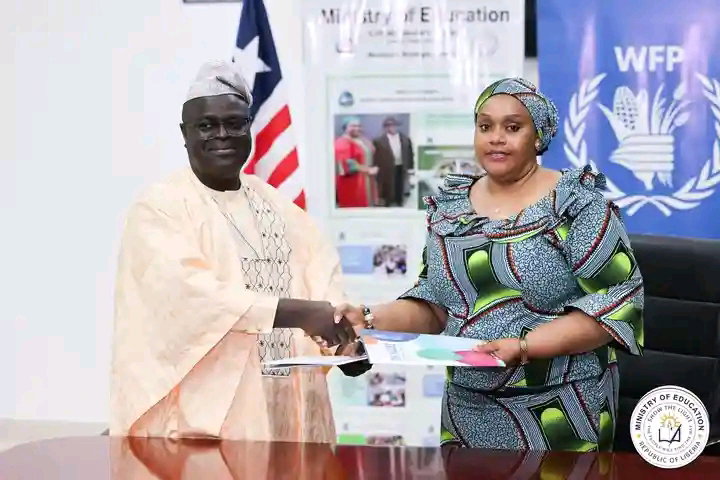
Dr. Jarso Maley Jallah, (R) signing new MoU with WFP Country Director Dr. Agbessi Komla Amewoa(L)
The reality on the ground is messier. Because while the MoU promises sustainability, it leaves unanswered the three questions that have broken school feeding in Liberia before: Where is the money coming from? How will food reach remote schools? And who will make sure it isn’t stolen along the way?
THE MONEY HOLE: BIG PROMISES, NO FIGURES
The agreement says government will take “increased responsibility for planning, financing and implementation.” What it does not say is how much.
No budget figure was announced. No percentage of the 2026 national budget was committed. No timeline for when government contributions will match or exceed WFP’s.
That matters because Liberia’s budget is already stretched. Education, health, and roads compete every year. Without a legally protected budget line, “increased financing” risks becoming a talking point that disappears in budget hearings.
WFP Country Director Dr. Agbessi Komla Amewoa called it a “transition, not withdrawal.” But transition to what? If government cannot guarantee funding in 2027 and 2028, then this MoU is just delaying the day the meals stop.
Parents know this. “We’ve heard ‘government will take over’ before,” said Josephine Doe, a Paynesville market seller with four children in school. “But when prices go up, the food is the first thing cut.”
THE LOGISTICS HOLE: 300 SCHOOLS, SAME BAD ROADS
Officials announced that the School Connect digital platform will expand to “more than 300 schools” for “real-time monitoring.”
It sounds good. It is not enough.
School Connect can report that a school in Grand Kru has no rice. It cannot drive a truck there. Liberia’s feeder roads collapse every rainy season. Storage facilities in county capitals are limited. Fuel costs are high.
The previous programme already struggled with late deliveries. Adding 200+ more schools to the monitoring system without fixing transport and warehousing is just creating a faster way to document failure.
Minister of Education Dr. Jarso Maley Jallah said the meals “support enrollment, attendance, retention, concentration, and learning.” True. But a child in River Gee cannot learn fractions if the rice arrives 3 weeks late, or not at all.
THE ACCOUNTABILITY HOLE: DATA WITHOUT CONSEQUENCES
In pilot schools, School Connect cut reporting delays from two weeks to 24 hours and flagged “cases of food diversion.” That’s useful.
What the Ministry did not say: What happened to those cases? Were officials sanctioned? Was food replaced? Were communities compensated?
Technology without enforcement is just theater. If headteachers can still fudge numbers, if county officials can still divert supplies, then expanding the app to 300 schools only scales the problem.
Community PTAs are barely mentioned in the MoU. Yet they are the ones who see empty pots at 12 noon. Without real power to audit and complain, School Connect becomes another dashboard in Monrovia that no one acts on.
THE LOCAL PROCUREMENT DREAM THAT KEEPS FAILING
The agreement touts “more food sourced from Liberian farmers.” This has been in every school feeding plan for 10 years.
The problem: local supply chains are weak. Farmers cannot produce rice at the volume and quality needed year-round. There is no guaranteed payment system. And without cold storage, perishables rot before they reach schools.
So in practice, “local purchase” often means 80% imports with a few bags of local beans for photos. Until government invests in aggregation centers and forward contracts, this part of the deal is aspirational.
WHY THIS MoU FEELS LIKE DEJA VU
This is not Liberia’s first handover plan. WFP has been “transitioning” school feeding for years. Each time, the script is the same: new MoU, new targets, new app, and two years later — funding gaps and hungry kids.
The difference now is the deadline. 2028 is three school years away. If government does not lock in financing in the next budget cycle, schools will feel the cut just as WFP scales down.
Headteacher Madam Kollie in Bomi sees it daily. “Attendance went from 60% to over 90% because of meals,” she said. “If the food stops, those children will disappear from my register. That’s not a projection. That’s what happened before 2018.”
WHAT MUST HAPPEN OR THIS FAILS
If this agreement is serious, three things must happen immediately:
Publish the budget. Put the exact 2026-2028 allocation in the national budget and protect it from cuts. No figure, no credibility.
Fix the last mile. Pair School Connect with contracts for transport, storage, and county-level warehouses. Data is useless if trucks can’t move.Give communities power. Let PTAs audit deliveries and report directly to the Ministry. Publish monthly School Connect data by school, not just county totals.
Without those, “national ownership” is just a slogan for donors.
If fact, no one disputes that school meals work. They keep kids in class and help them learn. That’s why this critique matters.
A new MoU is easy. Feeding a child in Maryland County in May, when the roads are gone and the budget is late, is hard.
Until Liberians see trucks, rice, and transparent numbers, the promise of 2028 will feel like another press conference.
For parents like Josephine Doe, the question is simple: “We welcome the plan,” she said. “We just pray the food does not stop.”
Prayer is not a policy. Budget lines are.
Liberia SchoolFeeding WFP Liberia Ministry of Education National Ownership School Meals Dr Jarso Maley Jallah Dr Agbessi Komla Amewoa Budget Gaps Food Insecurity Accountability Corruption Logistics Feeder Roads School Connect Food Diversion Sustainability Education Funding Monrovia Liberia Grand Kru River Gee Bomi County Maryland County Lofa County Nimba County. SDG 2 Zero Hunger Social Protection Public Finance Education Policy National Budget 2026 Donor Transition Local Procurement
Comments
